A Most Tragic Death: Willis T. Green

by Kristine Schmucker, HCHM Curator

(Note: This is part two of a three part series on the Opera House Fire on January 1, 1915) Click here for Part 1.

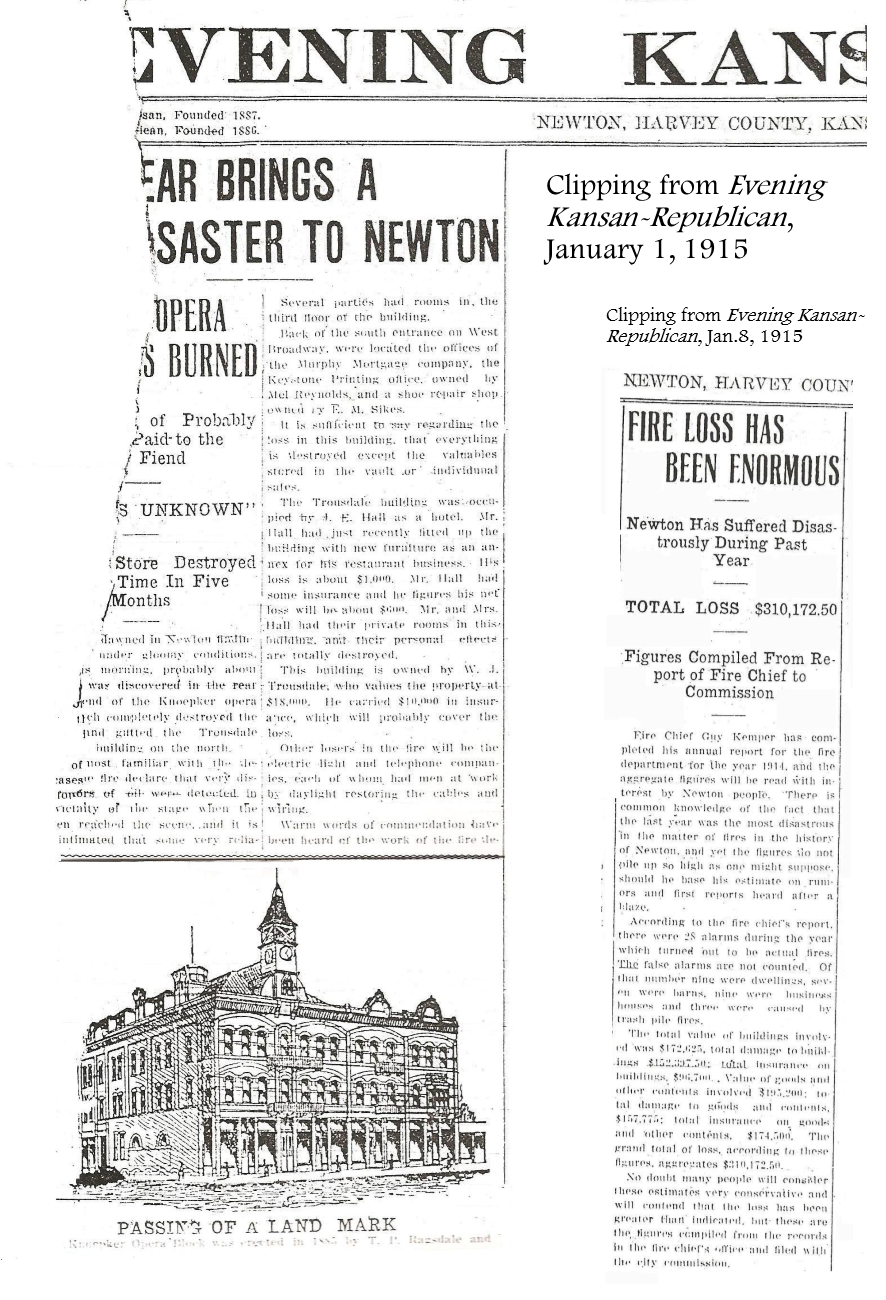
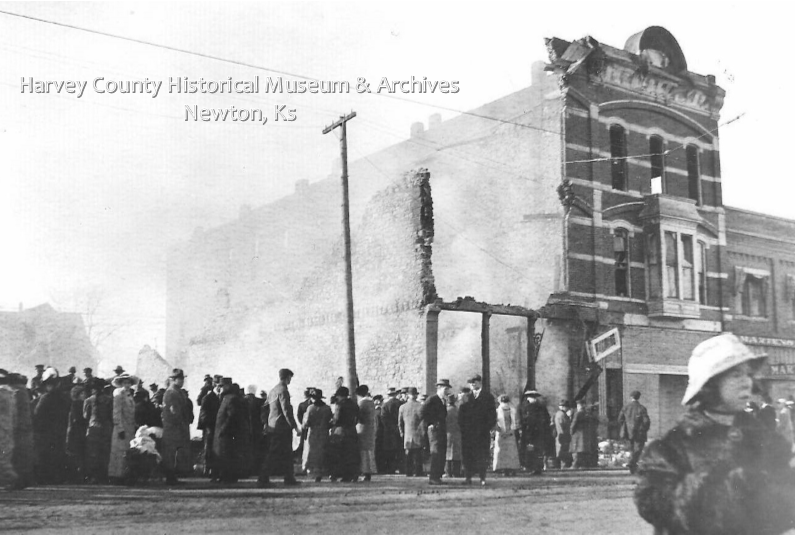
On the evening of Dec 31,1914 around 7:30, W.T. Green, age 70,  walked with a friend, Albert Nichol, from the Arcade Hotel to his room on the third floor of the Knoepker Opera House.  At 2:30 in the morning on January 1, 1915 fire was reported at the Opera House.  Within an hour the entire structure was involved.  The next morning, people began to realize that no one had seen Mr. Green since 7:30 the night before, and the worst was feared.

“Several witnesses of the fire have stated that they saw a man at the window in the room which was occupied by Mr. Green.”  The man stood “at the window for a brief while.  He appeared there in an undershirt, then in a moment disappeared. . .. No one of the big  crowd that gathered around the ruins this morning had seen Mr. Green since last evening.”
fire-3

A group of about forty men worked  to move debris in the area where they believed Green’s rooms would have been. At about 2:00 in the afternoon, Phil Lagree, foreman of the Newton street department, “picked up something with his shovel that looked like flesh.”  The paper  noted that even though “his features were unrecognizable” the body of W.T. Green had been found. From the location of the body, it looked “as though he had made an effort to get out in the hallway when the floor caved in.”

Newton Kansan Republican, 2 January 1915

Newton Kansan Republican, 2 January 1915

Green, a Civil War veteran, was an early settler in Harvey County.  Born in Putman County, Ohio, in November 1846, Green served with the 194th Regiment Ohio Volunteers Infantry Company I in 1865.   He moved to Harvey County in 1872 with his wife, Mary Smith Green, and three children. Here, he homesteaded a hundred and sixty acre farm in Darlington Township, section 15.

Darlington Township, Sect 15, 14,22, 23. Edwards Plat Map, 1882

Darlington Township, Sect 15, 14,22, 23. Edwards Plat Map, 1882

After several years, he moved to Newton.  In 1898, he served as a clerk of the district court and for several years, worked as engineer at the city water works. His wife, Mary, died in February 1905.  For the last years of his life, Green, was not employed and lived on the third floor of the opera house where he felt “at home in his old room.”

On that night, Green was unable to escape the blazing building.

The Kansan reported;

“During the excitement of getting the people out of the rooming house . . . it was not known that he had not escaped . . . when several remembered having seen a man’s form at the window . .   the whole building was in flames and had it really been known for a certainty that a man was in the building, it would have been impossible for any one to attempt to rescue him.”
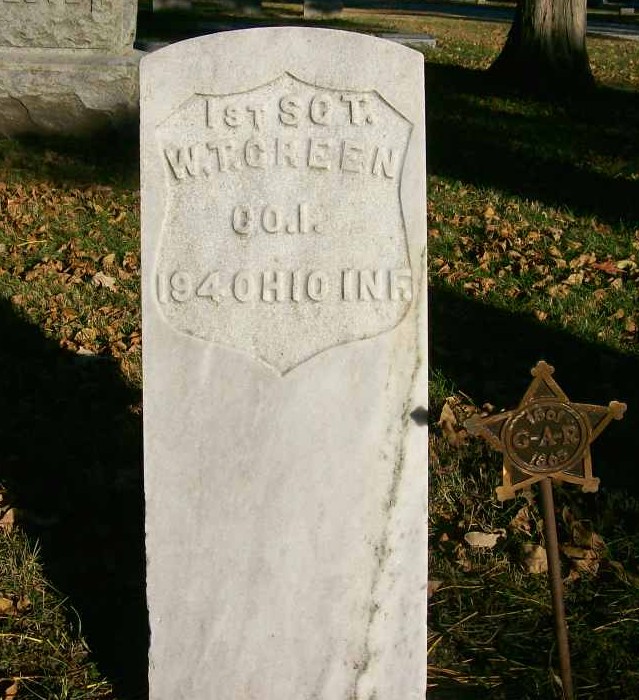
Willis T. Green, Marker Greenwood Cemetery, Newton, Ks, courtesy Jullian Wall

Willis T. Green, Marker Greenwood Cemetery, Newton, Ks, courtesy Jullian Wall

Green was survived by three children, Mrs. Joe Shuck, Mrs. L.C. Palmer and Frank C. Green and was buried in Greenwood Cemetery, Newton, Ks.

Sources:

  • Newton City Directories: 1885, 1887, 1902, 1905, 1911, 1913.
  • Evening Kansan Republican, 1 January 1915
  • Newton Kansan Republican 2 January 1915, “Willis T. Green Met Awful Death”, p. 1.
  • Evening Kansan Republican, 1 January 1915
  • Newton Journal 8 January 1915.
  • Newton Kansan Republican, 6 February 1905 “Mrs. Willis Green Dead”, p. 1
  • Edwards Atlas, Darlington Township, 1882.
  • 194th Regiment Ohio Volunteers Infantry Company I at http://www.civilwarindex.com/armyoh/rosters/194th.oh.inf
  • U.S. General Index to Pension Files, 1861-1934, Wilson t. Greene, 1890.
  • U.S. Veterans Administration Pension Payment Cards, 1907-1933, Wilson T. Greene, 1907-1933.
  • Sgt W.T. Green, Find A Grave Memorial #43771804
  • Mary E. Greene, Find A Grave memorial #43771835
  • Burial Record for Willis T. Greene and Mary E Greene at http://newton.harvey.ks.govern.com/cmquery
  • Fent, Mary Jeanine. Ragsdale Opera House — Newton, Kansas, 1885-1915. MA Thesis, University of North Carolina at Chapel Hill, 1977. HCHM Archives.
  • HCHM Photo Archives


Next week, Part 3 will conclude the series with businesses affected by the fire.
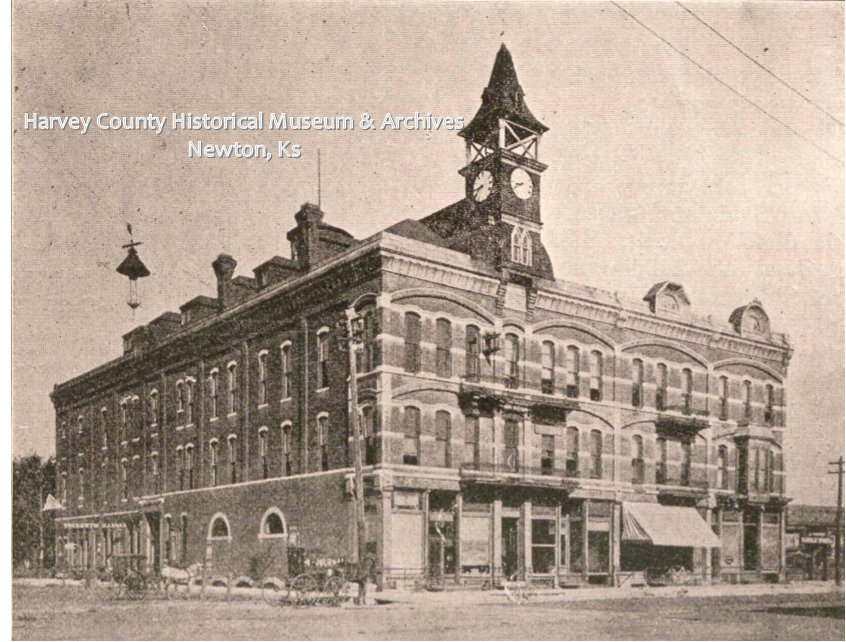
New Year’s Day Disaster: Ragsdale Opera House

by Kristine Schmucker, HCHM Curator

The Ragsdale Opera House, 1885-1915

The Ragsdale Opera House, 1885-1915

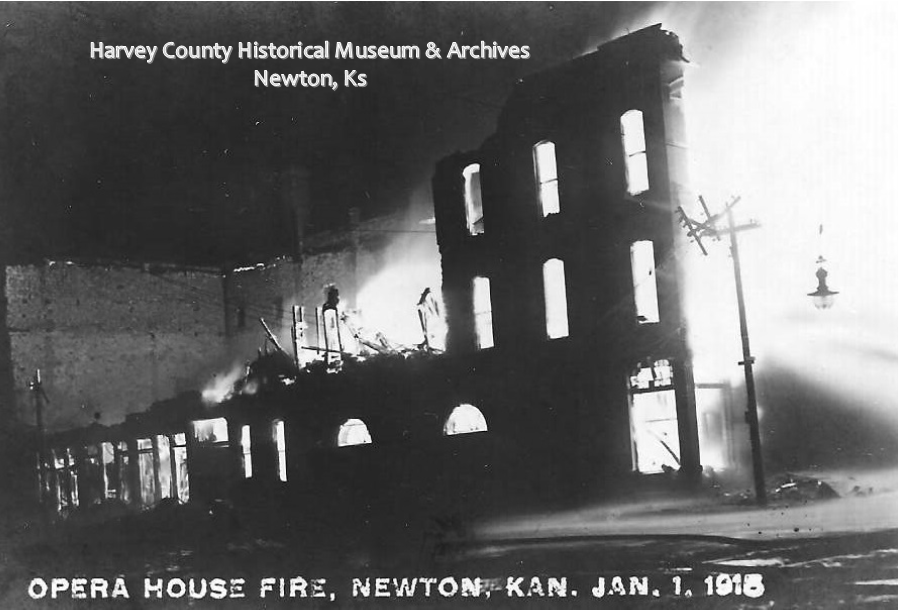
Early Morning, New Year’s Day, January 1, 1915.

Early in the morning on New Year’s Day in 1915, Hal Somers and Mary Russell, ran out of gas on their way home from the Knights Templar Ball and New Year’s Eve lunch at George Glenn’s.  As a result, they were walking through town at about 2:30 am.  They had reached Broadway and Main, when they noticed a light coming from the back of the otherwise dark opera house. They “soon discovered a blaze coming out of the back door in the second story.”  They ran to a nearby home and sounded the alarm.

“In a remarkably short time the rear of the building was ablaze all over, and by the time the fire department reached the scene it had gained considerable headway.”

Ragsdale/Knoepker Opera House, 1 January 1915.

Ragsdale/Knoepker Opera House, 1 January 1915.

While the firefighters worked to get the fire under control and keep it from spreading to neighboring buildings, other volunteers tried to save what they could, carrying out valuables and merchandise.

The Newton Journal described the scene.

“In less than an hour the flames licked up the offices and shops at the west end and swept through the McManus dry goods and clothing store at the front of the building and the south wall and belfry were down.”

The Weekly Kansan Republican noted the loss of the clock, 45 minutes after the fire was discovered.

“The last time the old town clock struck the hour was at the third hour of the New Year, and at fifteen minutes after three the hands of the clock dropped from sight.”

By daylight, the entire building, a landmark since 1885, was gone.

Opera House Fire. Photo taken by Lucile Mitchell Miller, January 1, 1915.

Opera House Fire. Photo taken by Lucile Mitchell Miller, January 1, 1915.

fire-3


Evening Kansan Republican, 2 January 1915

Evening Kansan Republican, 1 January 1915

30 Years Earlier, Spring 1884

Two brothers, James M. and Thaddeus P. Ragsdale, decided to invest in the future of Newton, Ks.  Already successful businessmen, the brothers sold their grocery business in 1879 and began “dealing in real estate.” Using their own money, they bought lots, built homes or businesses and sold the improved property.  They added over one hundred houses and seven business blocks to Newton. (Fent, p. 24)  In 1884, they turned their attention to their largest project, building an opera house at the corner of Broadway and Main.

It took a year and a half to construct the Ragsdale Opera House beginning in May 1884 and completed in  1885. The massive three story structure covered  three lots at 701 Main. Although the exterior had brick and stone, the interior was entirely wooden. The brothers paid $8,000 for the lots and the nearly completed structure cost eighty thousand dollars.

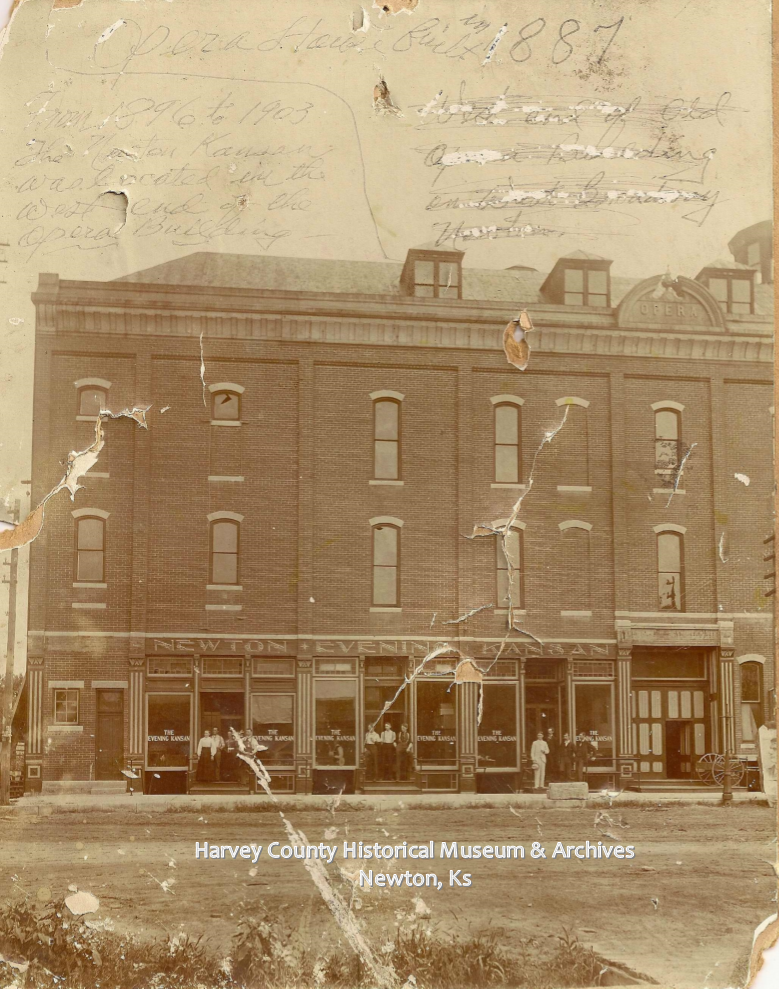
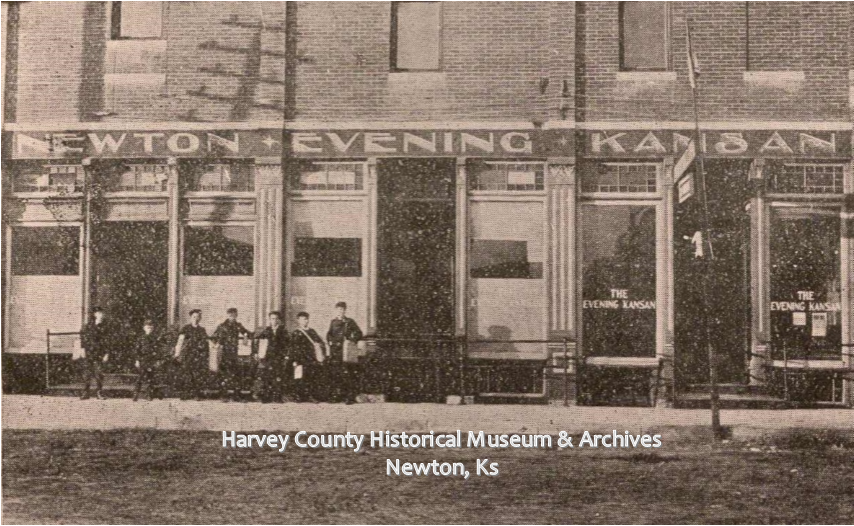
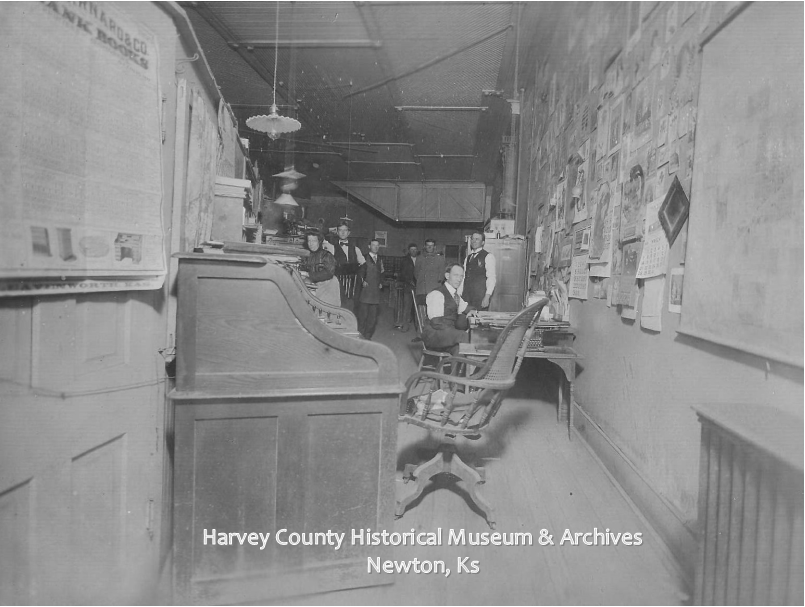
The ground floor consisted of businesses, including the Newton Kansan.   Phil H. Knowlton, editor of the Daily and Weekly Kansan (1896-1898) recalled that “it was in the basement of this historic building that I began my newspaper career” after graduating from Newton High.

Newton Kansan, Ragsdale Opera House, Broadway & Main, 1887

Newton Kansan, Ragsdale Opera House, Broadway & Main, 1887

Detail of Newton Kansan Offices, Ragsdale Opera House, Broadway & Main, 1887

Detail of Newton Kansan Offices, Ragsdale Opera House, Broadway & Main, 1887

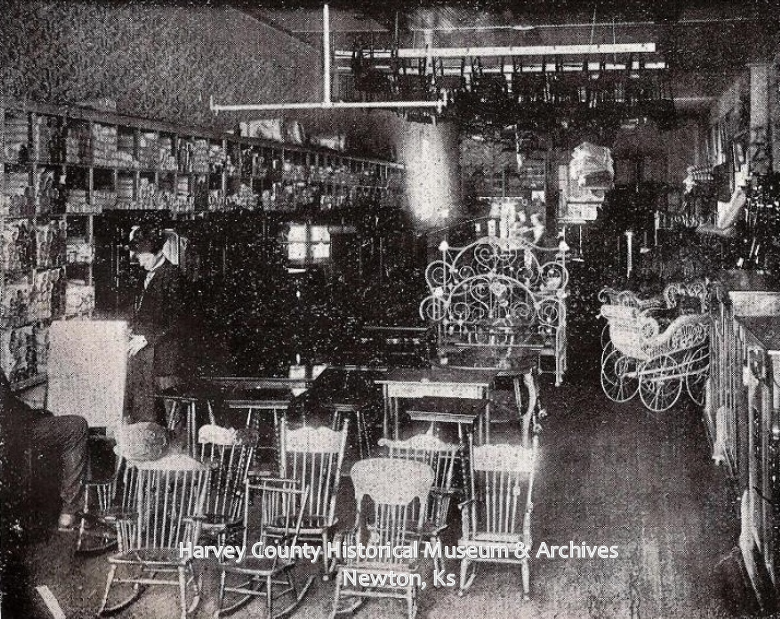
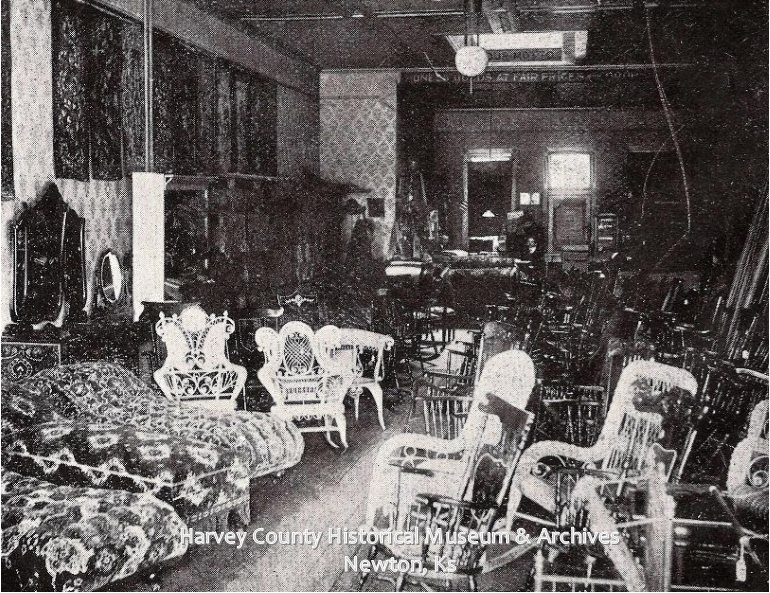
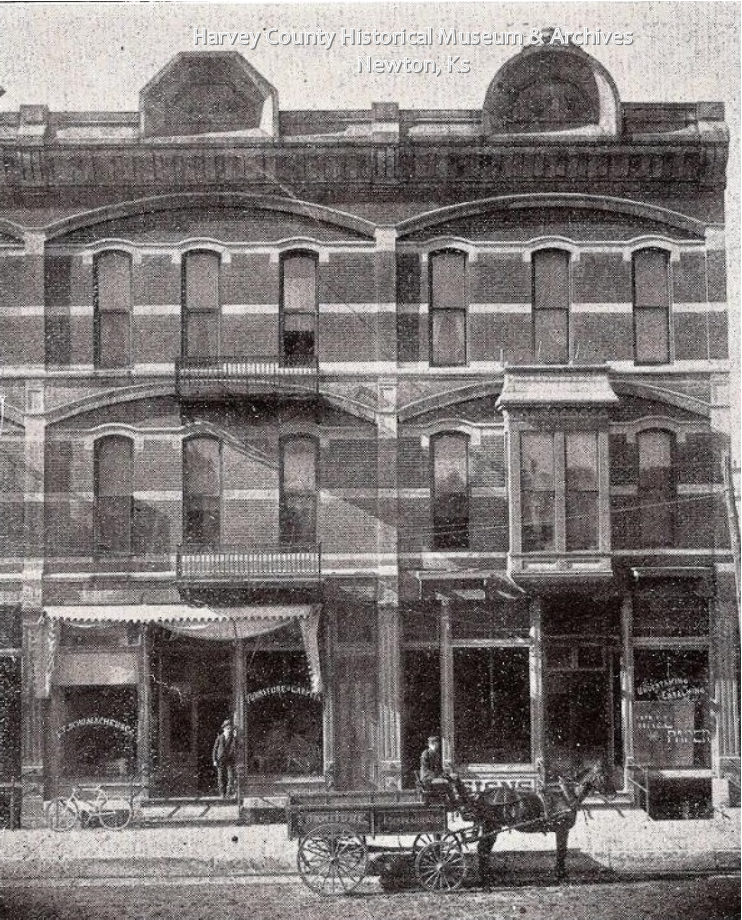
Other businesses included Schumacher’s Furniture.

interior-3

Schumacher's Furniture Business, Interior, 1901

Schumacher’s Furniture Business, Interior, 1901

Schumacher's Furniture Business, exterior, 1901

Schumacher’s Furniture Business, exterior, Opera Block,1901

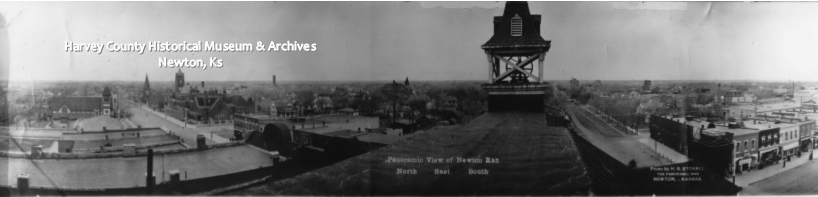
The east section of the structure had eight rooms each on the second and third floors with several used for apartments. A winding staircase led to an observatory and a three faced Seth Thomas Clock. The six hundred dollar clock  was paid for by donations from the community.  The clock had a six foot dial and a six hundred pound bell which, some claimed, could be heard from two miles away on a clear day.

Panoramic View taken from the roof of the Opera House, Main and Broadway in 1911 by Stovall Studio.

Panoramic View taken from the roof of the Opera House, Main and Broadway in 1911 by Stovall Studio.

The Post Office was located in a space along Main Street until 1912 and for some of that time tickets to performances were available.

Post Office in the Ragsdale Opera House, 1903. Man on the left is Guy Sawyer and the far right is Chalres Benfer.

Post Office in the Ragsdale Opera House, 1903. Man on the left is Guy Sawyer and the far right is Charles Benfer.

The actual theater was located at the west end on the second and third floors.

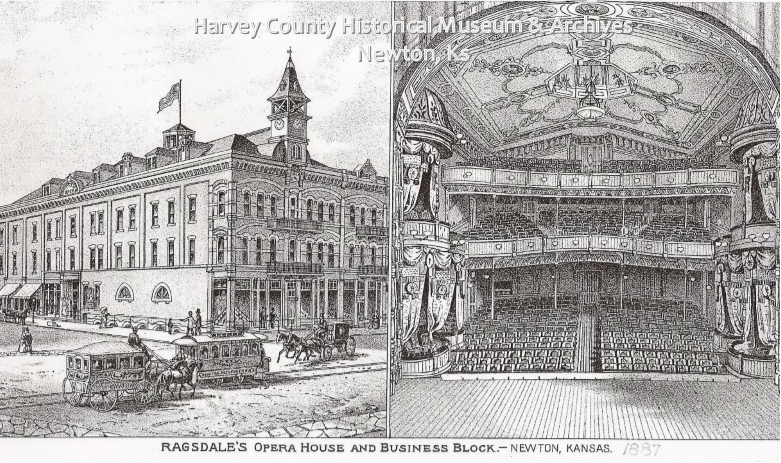
The main entrance to the actual theater was on Broadway and was marked with a semi-circular sign “Ragsdale Opera House.”  This was the only indication that it was an opera house on the exterior.  From a small lobby, patrons would go up the main stairway, which was constructed of oak and “gracefully curved up up to the main theatre lobby.”   There was a smaller secondary staircase from the Main Street entrance. The house itself had three levels and seated eight hundred in addition to eight private boxes which could seat five each. The ceiling had ornate frescoes and the walls and woodwork were painted a dark red.  Over the next several years, the interior would be repaired, cleaned, and repainted several times. The last improvement to the theater was made in 1911-12, when it was again cleaned and the drop curtain repainted.

Ragsdale Opera House, 1885

Ragsdale Opera House, 1885

In a remembrance column for the 50th Anniversary of the Newton Kansan, Knowlton described the Opera House “as the town’s pride and joy-parquet, balcony . . . ‘neverything.  

Gas lights were furnished by a Hagen & DeWitt gas machine in the basement.  And the boxes! Varied-colored rosettes, fringes, draperies and gingerbread stand out in my memory as a creation worthy of a patch-quilt super-artist!”

The Ragsdale brothers lost possession of the opera house on 11 August 1892, as a result of the financial panic of 1890 which was particularly hard on those who had invested in real estate. Despite several new owners, the building continued to be known as the Ragsdale until November 1907. The new owner had the name plate obliterated and replaced with the name “Knoepker Opera House.” At about the same time, changes were made to comply with the latest fire regulations.

By 1910, the building was showing its age and deteriorating from general neglect.  At that time, the possibility of constructing a new opera house was briefly discussed.  However, nothing ever came of the discussions.

For thirty years, the Opera House was a Newton landmark, home to several businesses and the main center for entertainment.

On that early New Year’s Day morning, the community lost more than an aging building.  One life was lost, several businesses lost everything and a unique historical landmark was gone.  The cause of the fire was believed to be broken gas pipes in the southwest room of the stage.  However, local residents claimed that a “distinctive odor of oil was detected in the vicinity of the stage” causing many to suspect arson. The actual cause of the fire was never verified.

Part 2: The fate of  Willis T. Green, who was living in rooms at the opera house, was not known until a day later.  His story will be the focus of our next post.

Part 3: Several businesses also lost a great deal. For one man, T.H. McManus, it was the second time he was forced to rebuild after a fire destroyed his business. Part 3 of our series on the Ragsdale Fire will conclude with stories of various businesses that were affected.

Sources:

  • Newton Republican, 11 December 1885.
  • Newton Kansan, 12 November 1885.
  • Evening Kansan Republican, 1 January 1915,
  • Newton Journal 8 January 1915.
  • Early Fire Protection In Newton, Kansas, 1872-1922.
  • Newton Kansan 50th Anniversary, 22 August 1922.
  • Fent, Mary Jeanine. Ragsdale Opera House — Newton, Kansas, 1885-1915. MA Thesis, University of North Carolina at Chapel Hill, 1977. HCHM Archives.
  • HCHM Photo Archives

The Tradition Will Continue! Tastes of Christmas


Walk on Main Street in Newton near the corner of 6th Street and if you are lucky you will get a whiff  of baking peppernuts from Prairie Harvest.   For many families in Harvey County, peppernuts are a traditional Christmas treat that has a long history.

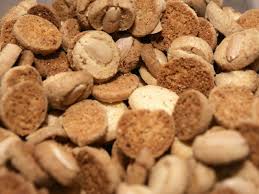
A nut-sized spice cookie the earliest recipes call for black pepper  and ginger with several basic ingredients, honey, eggs and flour.  During the Middle Ages, black pepper was one of the most expensive of the spices, adding to the special nature of foods made with it.  Baking peppernuts became a tradition among Mennonites living in Russia and when they immigrated to Kansas in the 1870s, they brought their recipes with them. Since that time, peppernuts have remained popular and as new, different ingredients were available,  the recipes changed. In her book, Mennonite Foods & Folkways from South Russia, Norma Jost Voth concluded:

“The best peppernuts are crisp and very spicy.  Anise is the most popular flavor.  Pepper enhances the other spice flavors.  The plain, traditional peppernut is still very good.  The tradition will continue!”

Today, peppernuts are enjoyed by many families in south central Kansas and several individuals and businesses bake them to sell.

peppernuts

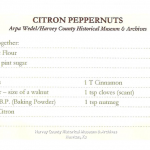
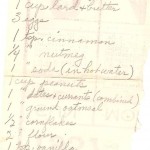
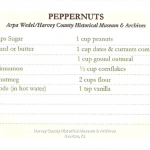
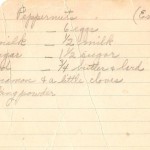
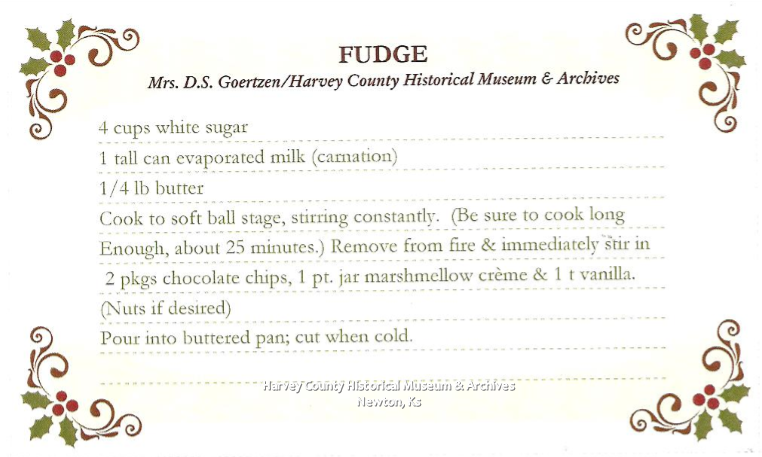
Below are three recipes for peppernuts and one fudge recipe from Arpa Wedel’s Recipe Box. Arpa Wedel (1914-2003) grew up in Marion County and lived and worked as a teacher in Marion and Harvey Counties.  Her recipe box features traditional favorites as well as new dishes to try.

Click on images to enlarge recipe cards.

Citron Peppernuts (or Russian Peppernuts)


 Peppernuts 

Esther’s Peppernuts

Fudge
Fudge is another Christmas treat.  Below is a recipe that Arpa got from Mrs. D.S. Goertzen.
Mrs. D.S. Goertzen’s Fudge
fudgegoertzenfudge
 Sources:
  • Arpa Wedel’s Recipe Box, Private Collection.
  • Mennonite Weekly Review 8 September 2003, p. 12
  • U.S. Census, 1940.
  • Voth, Norma Jost.  Mennonite Foods & Folkways from South Russia: Vol. 1.  Intercourse, PA:  Good Books, 1994.