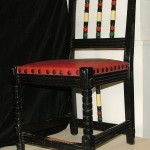
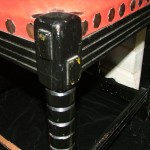
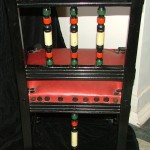
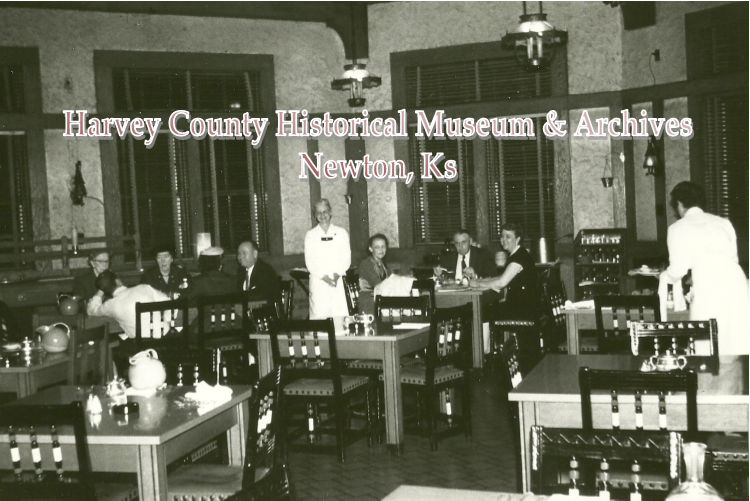
Four chairs were donated to the Harvey County Historical Museum in 1965 by the Santa Fe Railroad after the Newton Harvey House closed. At that time, no other history about the chairs was collected. At some point in their history, the chairs had been repainted and reupholstered, probably to match the decor at the Newton Harvey House.
Interior AT&SF Depot, Newton, Ks ca. 1950. Note chairs HCHM Photo Collection
While on exhibit at the National Archives, Tom Taylor, historian, noticed the chairs and identified them as designed by Mary Colter for the El Navajo Harvey House and Train Station in Gallup, NM. The El Navajo opened in 1923.
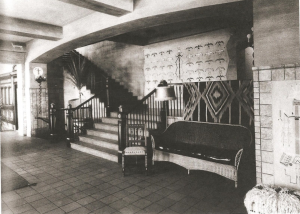
El Navajo Interior, 1923 in Berke, “Mary Colter: Architect of the Southwest”, p.133. Note Chair.
Mary Colter has been called “the best known unknown architect in the national parks.” A contemporary of Frank Lloyd Wright and a graduate of the California School of Design in San Francisco, Colter worked exclusively for the Fred Harvey Company as an architect and designer from 1910 to 1948. The Fred Harvey Company had an exclusive contract with the Atchison, Topeka & Santa Fe Railroad to provide meals and hotels to travelers and Colter designed the hotels with her own style.
From the beginning of her career, she utilized indigenous influences to create buildings that fit their environment and reflected the culture around them. She was especially interested in the rich history and culture of the southwest, and this interest heavily influenced her work.
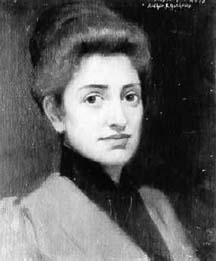
Mary Jane Colter in 1893
by Arthur Mathews
Courtesy of the Arizona Historical Society Pioneer Museum
Today, her work is receiving more attention and most people are familiar with her buildings at the Grand Canyon National Park, especially the Watchtower and Hermit’s Rest. Eleven of her buildings are on the National Register of Historic Places. Sadly, many other structures did not survive as highways were widened for increased automobile traffic, including the El Navajo in Gallup,NM.
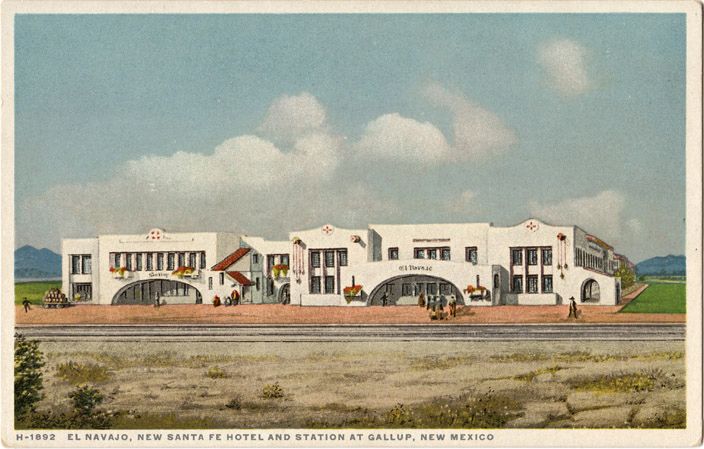
Constructed in 1923, El Navajo was a called a “harmonious celebration of diversity and appreciation” that utilized Native and non-Native elements of New Mexico. Despite initial concerns from the Native American community, Colter was able to use authentic Navajo sand-painting reproductions on the walls. When the hotel opened, a house blessing was conducted by 29 Navajo singers and medicine men.
Our chairs were part of the original furnishings designed by Colter for the hotel.
The El Navajo was torn down in 1957 to make room for a widened Route 66 and all the Navajo sand paintings were destroyed.
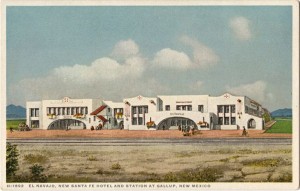
El Navajo, Gallup, NM. Postcard
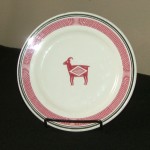
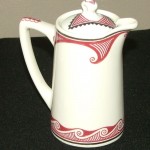
Mimbreno China
In the 1930s, Colter designed a china pattern that was inspired by the pottery of the Mimbres Indians that had lived in southwest New Mexico thousands of years ago.
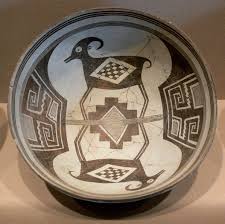
Example of Mimbres Pottery that inspired Colter.
She created thirty-seven different decorations for various pieces of china, many featured stylized versions of birds, animals and fish. The china was produced by the Onandaga Pottery Co exclusively for the Santa Fe Dining Car from 1936-1971.
Examples from our collection.
-
-
Salad Plate, Mimbreno Pattern
-
-
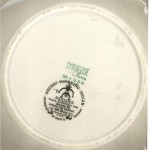
Salad Plate, back
-
-
Chocolate Pot, Mimbreno Patter
-
-
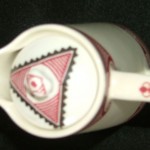
Chocolate Pot, detail
Mary J. Colter died in 1958. The buildings she worked so hard to create remain “part of the fabric of the Southwest” and continue to be admired by visitors to the Grand Canyon and other National Parks.
Sources:
- Berke, Arnold. Mary Colter: Architect of the Southwest. New York: Princeton Architectural Press, 2002.
- Grattan, Virginia L. Mary Colter: Builder Upon the Red Earth.
- Rennicke, Jeff. Mary Jane Colter: Architect. National Parks Conservation Association. http://www.npca.org/news/magazine/all-issues/2008/spring/mary-jane-colter-architect.html
- http://www.nps.gov/nr/feature/wom/2001/colter.htm
- http://newmexicohistory.org/people/mary-elizabeth-jane-colter
- http://www.gilawildernessexpeditions.com/cultures.htm
- http://anthropology.si.edu/cm/mimbres.htm