Stories Waiting to be Told: HCHM Archives

aam_2012

by Kristine Schmucker, HCHM Curator

“During the Civil War I was a member of Co F. 143rd Reg’t Ill Vol Infty. . . I have moved around a great deal since I was discharged from the Army.  It is Impossible for me to find two persons who could testify as to my condition from the time I left the Army down to 1891.” -Henry Guyott, 14 June 1906, Civil War Pension Records, HCHM Archives

Note dictated by Henry Guyott, age 58, on 14 June 1906 regarding his pension.

Note dictated by Henry Guyott, age 58, on 14 June 1906 regarding his pension. J.C. Johnston Civil War Pensions, HCHM Archives.

Henry Guyot was one of 287 men or their widows living in Harvey County that sought help from attorney John C. Johnston to apply for a pension for their service during the Civil War.  The files include information on service in the army, activity and health issues.  Some even give a glimpse into family life after the war.

Born in 1848 in Switzerland, it appears that Henry immigrated to the U.S  with his mother, Emira, brother and several cousins and settled in Illinois.  During the Civil War, he served served several months with the 143rd Illinois Infantry. He was approximately 17 years old.

After the war, Henry noted that he “moved around a great deal.”  The 1870 census records find him in Illinois living with his mother.  Ten years later he is still single, living in Sedgwick County, Kansas with his mother and cousin.

Effie M. Lantis (15) marriage to Henry A. Guyot (34), 20 October 1884. Marriage License Collection, HCHM Archives.

Effie M. Lantis (15) marriage to Henry A. Guyot (34), 20 October 1884. Marriage License Collection, HCHM Archives.

However on October 20, 1884, 34 year old Henry married 15 year old Effie M. Lantis at her parental home in Harvey County, Ks.  The couple made their home near Walton, Kansas and started a family.  Between 1884 and 1908, they had at least nine children.  Henry settled down to farm and raise his family. In 1891, at age 58, Henry applied for a pension for his service during the Civil War.  He may have dictated the above statement to John C. Johnston describing his service and health issues.

Civil War Pensions were offered to Union soldiers or their widows and minor children. The pension records in the collection include information on what the soldier did during the war in addition to medical information in the years following.

For example, Henry Guyot  noted that Dr. J.H. Goddard, a physician in Sedgwick, “often treated me for cataracts, deafness, scurvy (?), diarrhea and rheumatism.”  The files from other men describe injuries received during battle.

To obtain a widow’s pension, the widow had to provide proof of marriage, such as a copy of the record kept by county officials, or by affidavit from the minister or some other person. Applications on behalf of the soldier’s minor children had to supply both proof of the soldier’s marriage and proof of the children’s birth. For those reasons, Civil War pensions are  fascinating, because of the wide array of things people submitted as evidence.

Henry died 23 January 1915, and Effie in 1921. Their son, Ben and daughter Edith continued to live on the family farm until the mid-1960s.


Henry, Effie and three of their children are buried in the Walton Cemetery, rural Harvey County, Ks.

The John C. Johnston Civil War Pension Collection is just one treasure that is part of the Archival Collections at HCHM. Throughout the month of October, we will  feature the Archival holdings at HCHM and the behind the scenes work that happens to make the collections accessible.
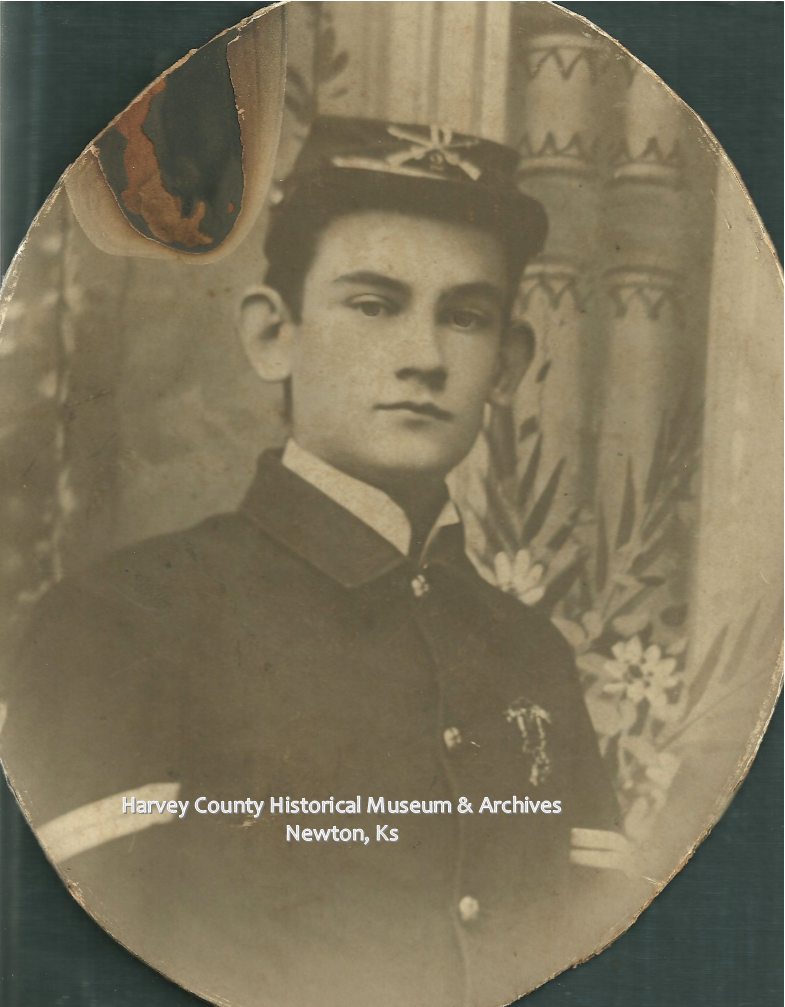
Unidentified man in uniform, ca. 1861.

Unidentified man in uniform, ca. 1861. Photo Archives, HCHM.

Sources:

  • US Census, 1870, 1880, 1900, 1910.
  • Marriage License Collection, HCHM Archives, Newton, Ks
  • John C. Johnston Civil War Pension Collection, HCHM Archives, Newton, Ks.
  • Kansas Census, Harvey County, 1885, HCHM Archives, Newton Kansas.

All the information related to the Guyot family for this post was discovered in the archives at HCHM.  What stories might you find? For more information on our Archives and the services available

Visit: https://hchm.org/research-library/

Call: (316)283-2221

Or e-mail: info@hchm.org
 

The “Most Effective of Visual Aides:” the WPA Diorama

by Kristine Schmucker, HCHM Curator

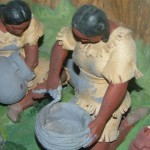
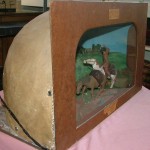
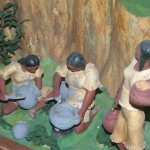
Years ago, students at Washington Elementary School walked past these stories without words; five dioramas depicting various scenes from the history of Kansas.  In one scene, three Native American women are shaping earthen pots and bowls.

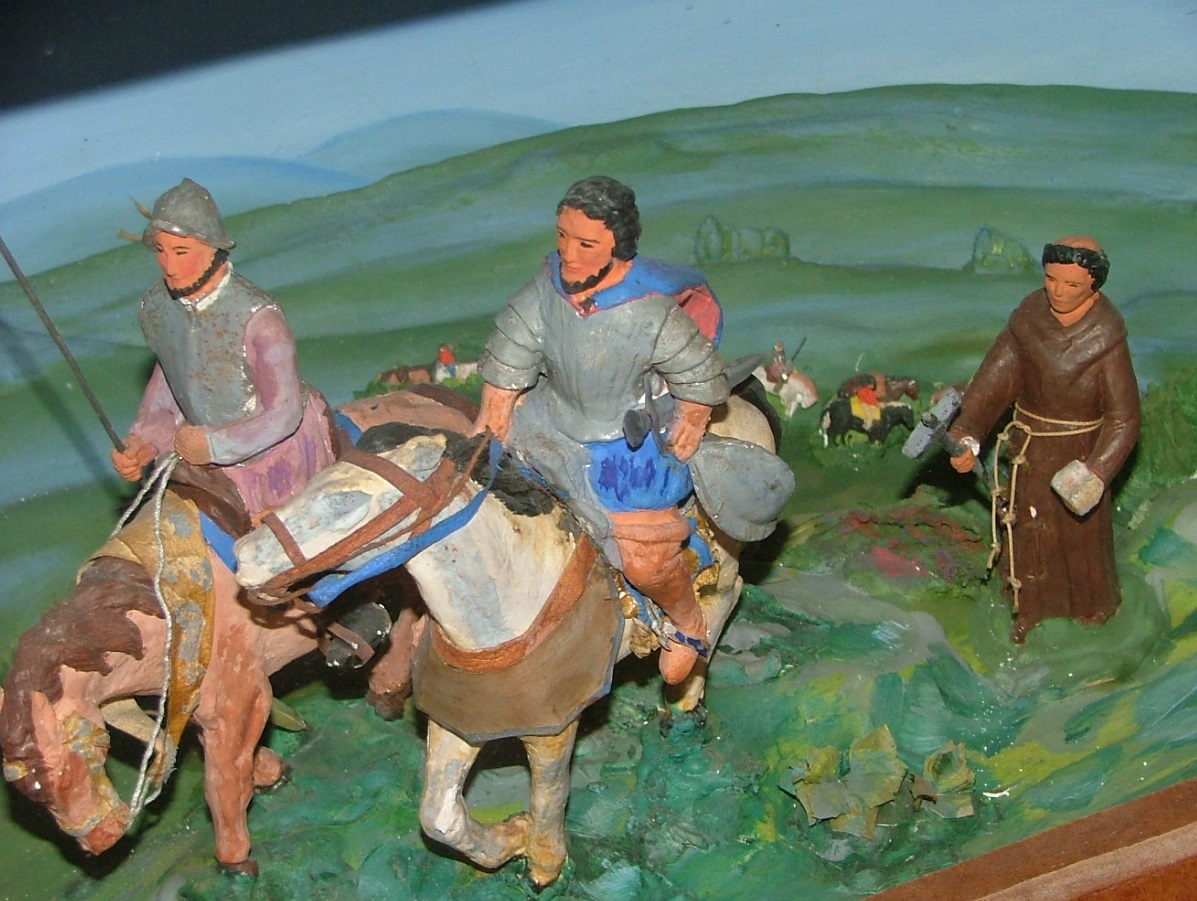
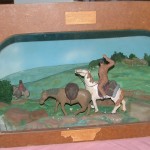
In another, Coronado marches across the Kansas prairie.

Detail of Kansas History Diorama No. 1, Coronado's March

Detail of Kansas History Diorama No. 1, Coronado’s March, ca. 1939-1941

The dioramas were purchased by Washington Elementary School, Newton, in the early 1940s and used in classrooms for a number of years. Eventually, the dioramas were put into storage at the school.  In 1986, they were rediscovered by local art teacher, Phil Epp.  He took them to his class room at Santa Fe Middle School to use in his classes.  When the Santa Fe Middle school was renovated in 2000, the dioramas were again put into storage.  Three years later, a case was constructed to exhibit the dioramas in the school.  Again, over time, their importance became lost and they returned to storage.  In the fall of 2014, the WPA Diorama Series was donated to the Harvey County Historical Museum & Archives, Newton, Ks.


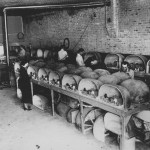
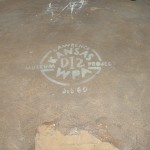
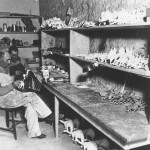
Most are probably familiar with the WPA Project, the federal work-relief program that hired the unemployed to build bridges, roads, and public buildings and parks during the late 1930s.  Less familiar is the program within the WPA that created these dioramas – the Museum Project.  There were twenty-four states that had programs to create these “most effective of visual aids.”  However, in only  four states, including Kansas, did the program, “develop into a dynamic state-wide organization offering a variety of art objects, artifacts and printed titles.”  The Museum  Progect hired unemployed artists, photographers, cabinetmakers and teachers to worked along side the ‘regular’ staff in museums.  An additional purpose was to “help public schools to obtain visual education aids designed to give life and reality to the things children study.”

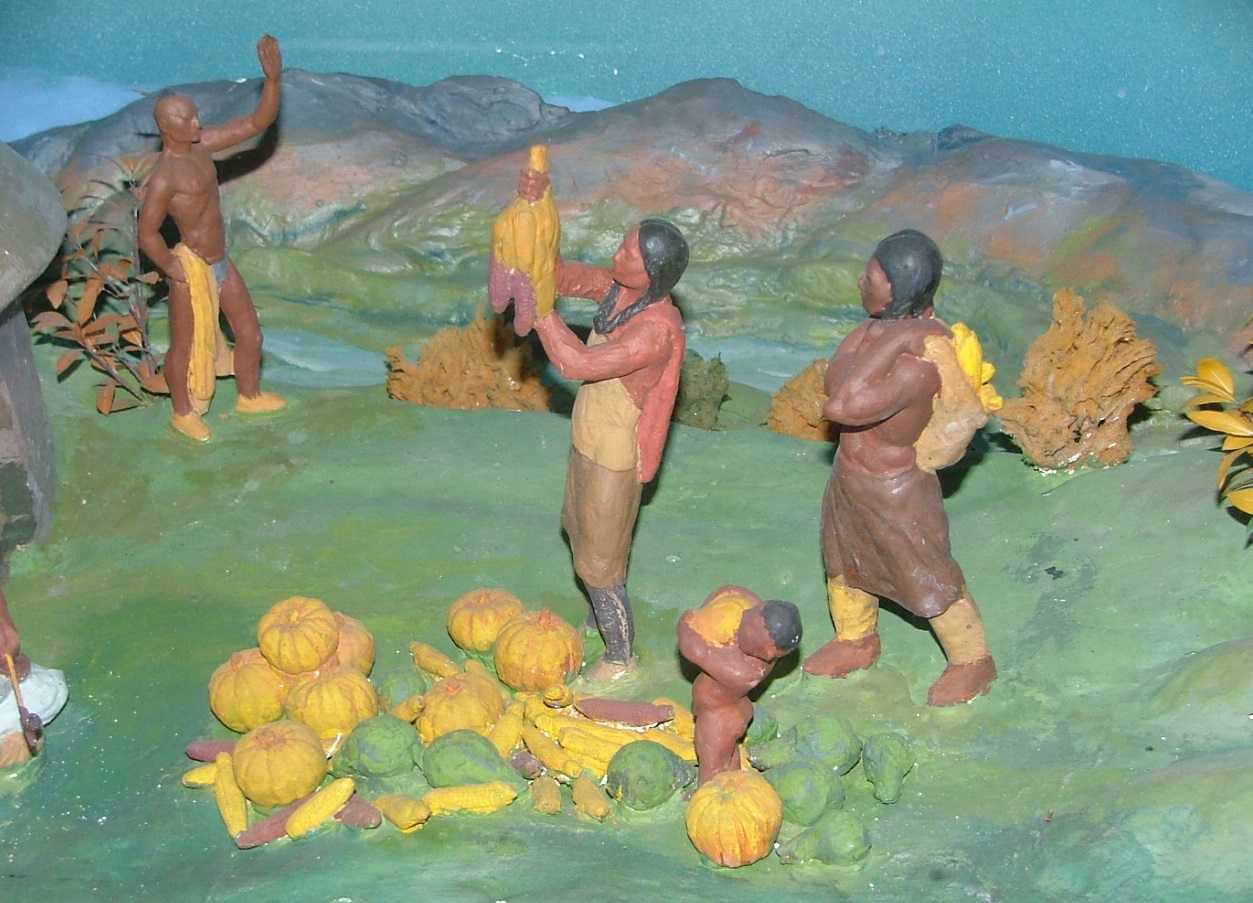
In Kansas, the Museum Project created several groups of dioramas depicting the life of early Indian tribes, and episodes from Kansas history.  Tax- supported educational institutions could order the dioramas they wanted from the Visual Aids Catalogue and Year Book.

There were three workshops where the artists created the dioramas.  The Newton set was made in Lawrence, Ks between 1939-1941.

The dioramas often depicted real places and actual historical events.  Kansas History Diorama No. 2, Four Horses Trading Post, also known as the  Choteau Brothers Trading Fort,  shows one of the earliest trading posts in Kansas.  The trading post was established in 1820-21 by two brothers Francis and Cyprian about twenty miles above the mouth of the Kansas River near present day Bonner Springs, Kansas.

The text provided along with the diorama describes the scene:

 “a beaver trapper and his Indian wife  approaching the Four Horses Trading Post. . . Pack horses carry bundles of raw pelts which will find their way to the fashion centers of the world.”

Detail of Indian Diorama No. 2, Kansa Harvest

Detail of Indian Diorama No. 2, Kansa Harvest

The program was overseen by the Kansas State Historical Society as reflected in the minutes for the Annual Meetings during the years 1936-1941.

Twelve to thirteen persons have been regularly employed in this building sixteen days a month on the Society’s unit of the state-wide WPA museum projects. These workers are supervised by the Society’s regular Staff members, and mention of their work assignments and accomplishments is made in departmental reports. Federal expenditures for the year from October 6, 1938, to October 5, 1939, were $9,901.34 for salaries. The Society’s expenditures for the same period were approximately $300 for working materials. (1939).

The Harvey County Historical Museum & Archives is happy to provide a new home for the dioramas.

Sources:

  • Beach, James H.  Notes on Kansas History, Vol II, No. 5, Hays, Ks, 1911 (Google Books)
  • Newton Kansan  7 November 2003, p.1
  • http://www.kshs.org/p/kansas-historical-quarterly-annual-meeting-1939/12810
  • http://www.kansasmemory.org/item/14893
  • http://mla.bethelks.edu/holdings/scans/wpa/
  • http://harveycountynow.com/2013/12/30/kauffman-museum-to-host-gallery-walk-for-exhibit-closing/
  • http://www.dioramasandcleverthings.com/2012/05/wpa-dioramas.html

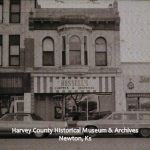
The Building at 815 Main

by Kristine Schmucker, HCHM Curator

In the early 1880s, Newton was growing.  The ‘rougher’ cowboys and the businesses associated with them had moved south to Wichita with the cattle trade.  Town leaders focused on building a community with stable businesses.  Several businesses were soon established along Main, just north of the railroad tracks between 5th and Broadway including banks, hotels and general stores.  The Ragsdale Opera House at the corner of Broadway and Main was completed in 1885.  North of the Opera House there was still plenty of room for businesses.  The First Methodist Church was located at the corner of 7th and Main. The new Harvey County Jail had just been completed between on the east side of Main between 7th & 8th, otherwise few businesses had moved that far north.  There were opportunities for growth in Newton, Kansas.

In 1883, 22 year old William Bergh, a native of

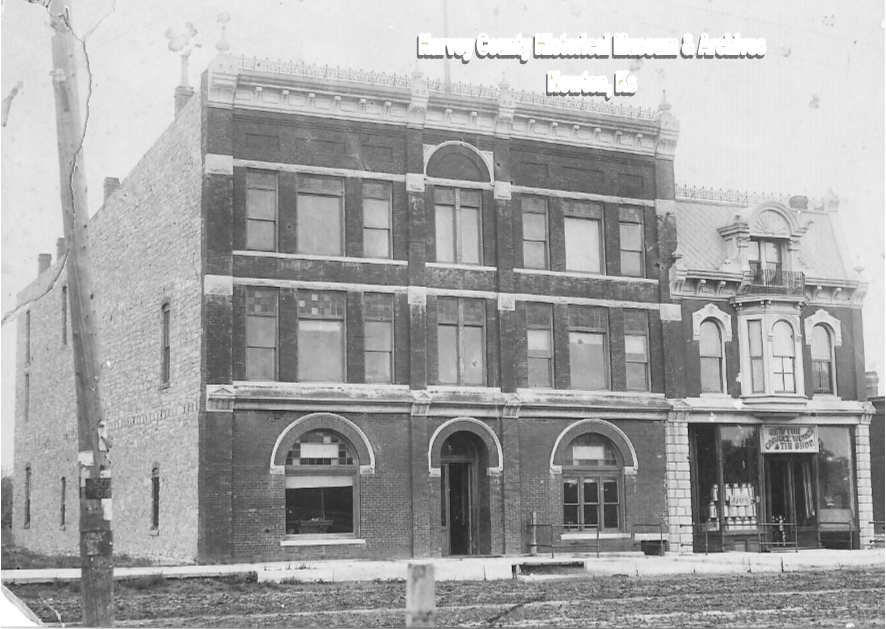
“Luxemberg, Germany,” arrived in Newton Kansas.  He must have been skilled at working with metal because within four years he established the Newton Cornice and Tin Works at 815 Main, next door to the Bretch Building which was built in 1888.

Bergh married Jeanette Dreyfuss on 23 November 1887 and they had two children.

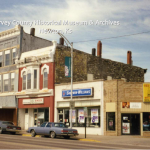
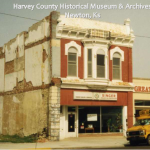
Bretch Building (811 Main) and Newton Cornice & Tin Works (815 Main) in 1910

Bretch Building (811 Main) and Newton Cornice & Tin Works (815 Main) in 1910

Bergh operated his business until 1918, when he retired.  His obituary stated that “he was the owner of the largest cornice and metal works business ever constructed in Newton.” Bergh died in 1933 at the age of 71.

Over the years, the building at 815 Main has been home to a number of businesses. Often the second floor served as apartments.

In 1971, it became the location of Cuellar Sewing Machine Co. Rosalio ‘Russ’ Cuellar grew up in Newton.  After graduating from Newton High, Cuellar worked for the Santa Fe Railroad, but soon he was looking for another opportunity.  He started working for the Singer Sewing Machine Co as a salesman and technician.  By 1967, he was able to open his own store in Newton. Four years later, he became the “first Hispanic business owner on Main Street in Newton” when he moved his business to the building at 815 Main.

In addition to his business, Cuellar served as a court interpreter and was active in various community organization and Our Lady of Guadalupe Catholic Church.  He married Judy Macias in 1951 and they had six children. Cuellar died in 2010 at the age of 79.

In 2003, the building at 815 Main was included in “Main Street Historic District No 2” on both the National Register and Kansas Register of Historic Places.  At that time the building was described as an

“elegantly designed building . . . one of the eye-catching gems of Main Street.  It has a three-sided bay window, topped by a cast iron railing; above a metal cornice with urn finials at each end, and a Mansard roof.”

Billie Jo Wilson, Historic Preservation Planner, City of Newton, provided additional architectural information from the nomination forms for the National Historic Register.

The architectural style and details were described as follows:

“This two-story, three-bay masonry building dates between 1886 and 1896.  It is one of the more high style Italianate buildings remaining on Main Street.  The ground floor has received some alterations, but it retains the door to the upper floor.  A substantial cornice separates the first floor from the second.  On the second floor, there is an ornamented, projecting three sided bay.  The front window opening is arched, and the two side windows of the bay are long, narrow rectangles.  The top of the bay is surrounded by a bracketed cornice, above which is a cast iron railing.  The windows on either side of the bay are also in arched openings, but unfortunately, all of the arched windows have been removed and replaced with flat top windows.  Above these arched windows are particularly ornate cornices. The second floor is capped by a large decorative bracketed metal cornice, featuring urn finials on each end.  Above this is a diamond patterned shingle roof, which looks like the bottom section of a double-pitched mansard roof.  There remains one metal cornice cap at one end above this shingled section.  The 1896 Sanborn Insurance map indicates that this was a three-story building with a framed roof, and shows a dwelling on the second floor and furnished rooms on the third.  The 1915 maps shows a third story, which this building appears to share with the three story building next door at 813 N Main as the Bethel Business College.  The adjacent three story building was demolished some time after 1963 [The building was demolished in 1994].  “The south wall of the current building, which would have been the party wall between the two buildings, is now stuccoed.  It is probable that the rest of the mansard roof was removed at the same time as the demolition of 813 N Main.  The north wall displays its limestone construction and retains two chimneys.”

Today, the building is empty.

Update June 18, 2019

The space has been re-imagined to a area for food trucks to gather.

Image may contain: outdoor

Image may contain: text

Sources:

  • Sanborn Insurance Company Maps, 1884, 1891, 1896, 1909, 1915.  HCHM Archives.
  • https://hchm.org/wp-content/uploads/2013/12/Marriage_List_Groom.pdf
  • Newton City Directories: 1885, 1887, 1902-03, 1905, 1911, 1913, 1917, 1973.
  • US Census: 1880, 1900, 1910, 1920, 1930.
  • Evening Kansan Republican 21 July 1933. William Bergh Obituary.
  • Newton Kansan, 22 April 2010.  Rosalio ‘Russ’ M. Cuellar Obituary.
  • Newton Kansan 30 June 2010 “Cuellar Sewing Shop, Wonder bread outlet close doors for good.”
  • The Historic Preservation Commission of Newton and North Newton, Ks.  At The Crossroads of Kansas: Architecture, History, and Preservation at Newton and North Newton, Ks, 2003.
  • Waltner, Rachel. Brick and Mortar: A History of Newton, Ks Mennonite Library & Archives, N. Newton in Cooperation with the City of Newton, 1984.