Beyond a Little Strife – A New County Was Created

by Kristine Schmucker, HCHM Curator

Late in August of 1870, Judge R.W.P Muse left from Topeka, Ks and traveled west and south with several others. He later described some the journey through the vast prairie.  On August 28, the group followed the Chisholm Trail

 “down on the west side of Sand Creek as far as the mouth of  the creek, where we found Dr. T.S. Floyd, with whom we staid all night. . . . After traveling over thirty miles, we had seen no human habitation or sign of civilization, our way being through high prairie grass, often  standing above the height of our wagon wheels . . . When we first visited the county, large herds of buffalo were found in the western portion . . . especially where Burrton now stands, and between the two Arkansas Rivers.”

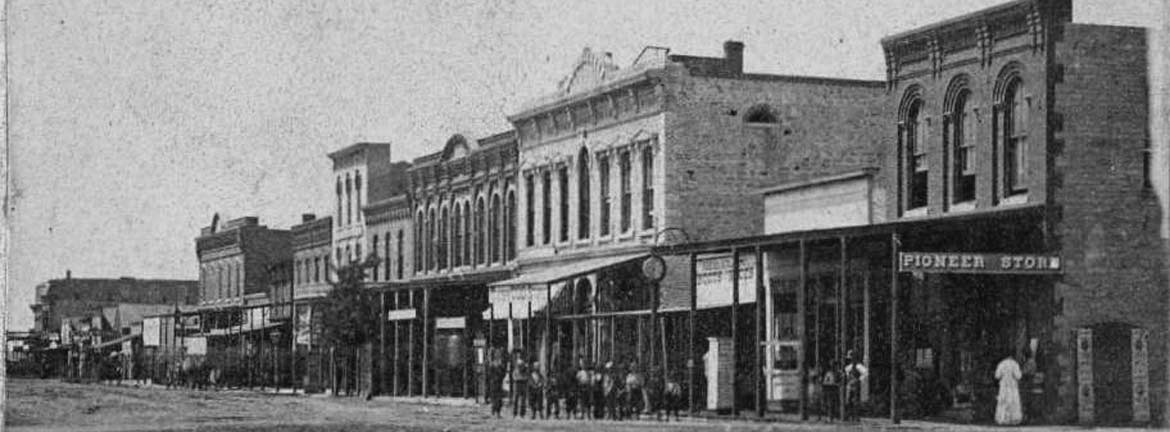
The town of Sedgwick already “did fair business” in 1870 according the Judge Muse in History of Harvey County, 1871-1881.  He also noted that “some enterprising and hardy pioneers . . . located in parts of the county as early as 1869.”  
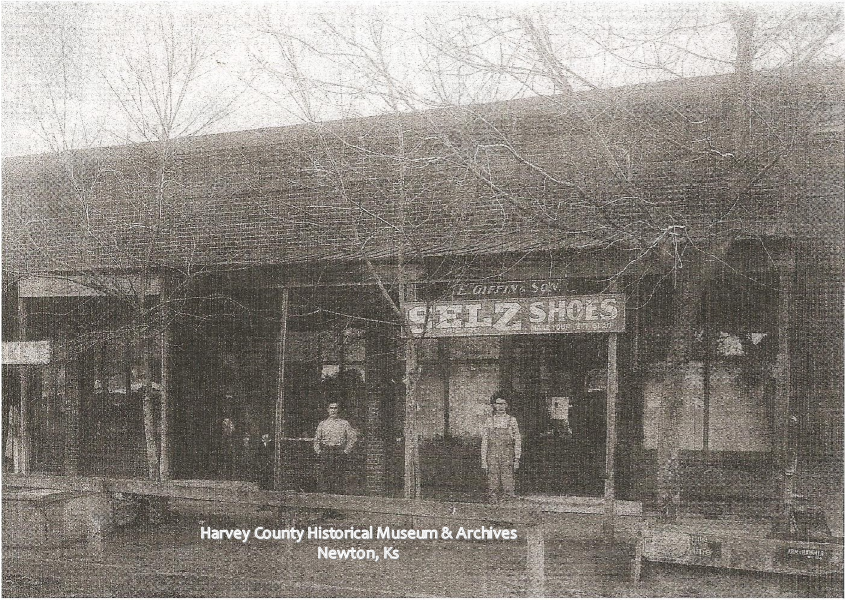
E. Griffin & Son, Selz Shoes, Elmon & John Griffin's Store, Sedgwick, Ks, ca. 1890.

E. Griffin & Son, Selz Shoes, Elmon & John Griffin’s Store, Sedgwick, Ks, ca. 1890.

With the arrival of the cattle trade and the railroad in the summer of 1871, the city of Newton grew rapidly and gained a reputation as wild and lawless. Muse, however, saw opportunity in the rough town and decided to stay.

After the shockingly violent summer of 1871 Muse reported that in the fall of 1871,

“the best citizens of the city and county . . . desired law and order to take the place of the disorder and moral confusion.  They began to consult for their own protection and the public good and resolved to organize . . . to establish a city and county government.”

Forming a New County

The way to a new county was not without difficulty as ten of the townships were part of Sedgwick County and the others part of Marion and McPherson Counties. Several meetings took place at the law office of C.S. Bowman in Newton to devise a way to create a new county.  The final push for a new county came after the Republican County Convention in Wichita. Seven delegates from Newton attended to nominate a county ticket for Sedgwick County.  Much their dismay, the Newton delegation was cut to three, and

after considerable debate and bad temper, all the Newton delegates, headed by the writer, [Muse] withdrew from the convention. . . The strife resulted in the nomination of two tickets, and most of the regular ticket was defeated.  This added to the feeling for a new county.” 

A meeting to establish a new county was held on December 13, 1871 in the office of Muse & Spivy, in Newton.  The group was able to get the support of Capt. David Payne, the representative in the Kansas legislature.  Several worked on completing the necessary paperwork including C.S. Bowman and Dr. Gaston Boyd. The new county would consist of sixteen townships, ten from Sedgwick, three from McPherson, and three from Marion.
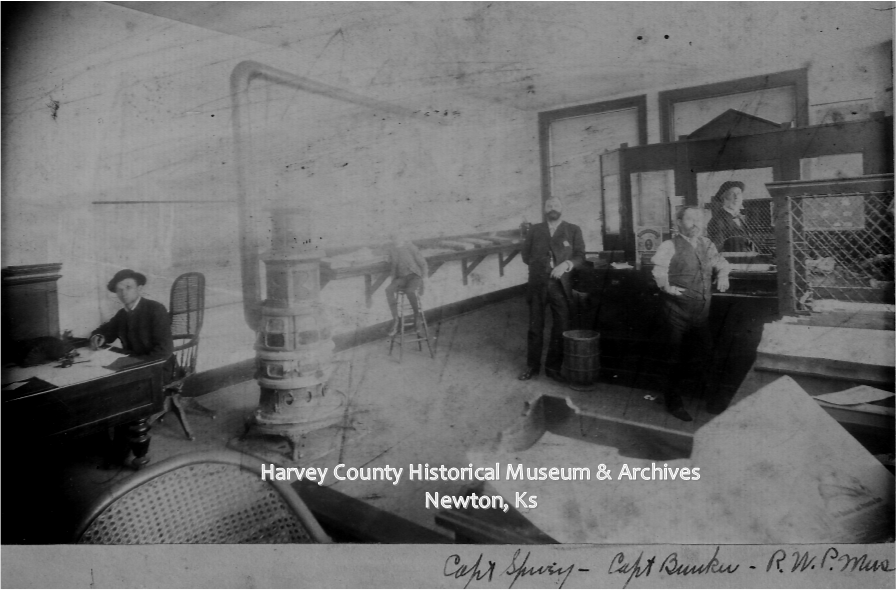
Office of Judge RWP Muse and Capt. Spivey, Newton 1872.  Spivey is sitting at the desk, Judge Muse is behind the counter and the man in front of the counter is identified as Capt. Bunker.  Fourth man is undientified.

Office of Judge RWP Muse and Capt. Spivey, Newton 1872. Spivey is sitting at the desk, Judge Muse is behind the counter and the man in front of the counter is identified as Capt. Bunker. Fourth man is undientified.

Harvey County organized by Act of Kansas legislature on 29  February 1872. The new county was named in honor of James M. Harvey, who was the governor of Kansas at the time.
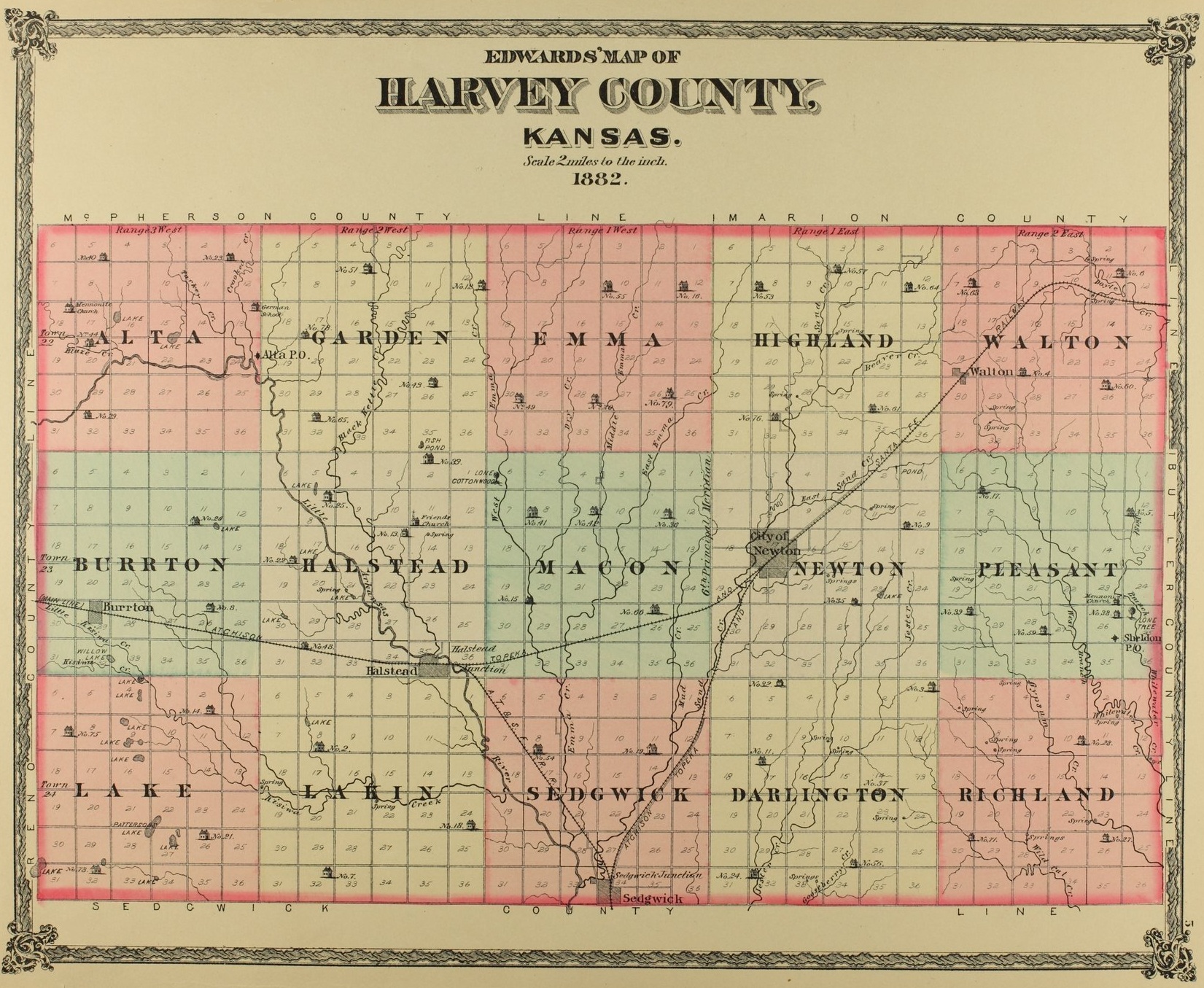
1882harvacountymap

A County Seat

Newton was designated as the county seat, but not without controversy.  A vote was held on May 20, 1872 for county officers and county seat. and there were some irregularities.

Judge Muse reported the following:

“The poll books of Sedgwick township showing up on their face an excessive and fraudulent vote, equal to more than double the amount of inhabitants in said township at the taking of the census about the 1st of April 1872, and the poll books of Newton township showing a large and excessive vote. . . The census of Sedgwick township taken and filed just before the election, showed that there were not to exceed one hundred and twenty-five legal voters residing in the township, yet the poll books showed that at the election over seven hundred votes had been cast. . . .It was reported that the names upon the Sedgwick poll books were copied from the Cincinnati Directory, and a colored bootblack who was plying his vocation there on election day, is reported to have . . . voted fourteen times.”

Muse concluded; “At any rate, beyond a little strife in court, no harm resulted and Newton was declared the county seat of Harvey County.”

The  Johnson Building located at the corner of Main and Broadway in Newton was designated as the location of the county offices.  The offices soon moved to a 526 Main.  Two years later, in 1875, the county offices were moved to the second floor of the Hamill Building at 513 Main.
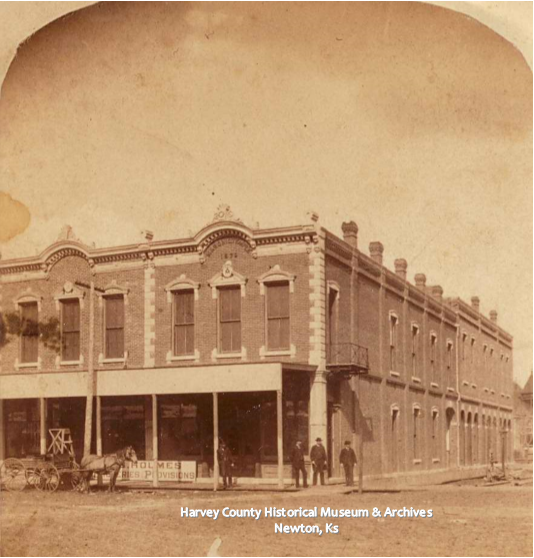
Masonic Building, 700 N. main, Newton, ca. 1880

Masonic Building, 700 N. main, Newton, ca. 1880

In 1880, the county offices were located in the Masonic Building at 700 N. Main.

In his concluding remarks on the history of the county, Muse noted that Harvey County  was

“filled with enterprising people, who take great pride in the thrift and prosperity of their respective towns, and whose public spirit ensures the steady growth of these cities, . . . and renders their success certain.”

*****All quotes are from “History of Harvey County: 1871-1881 by Judge RWP Muse, 1882.

Sources

  • “Death of Judge Muse” Newton Kansan 26 November 1896, p.1.
  • Muse, Judge R.W.P., History of Harvey County: 1871-1881. Newton, Ks: Harvey County Historical Museum & Archives, 2013. Originally published in Edward’s Harvey County Atlas, 1882.
  • Bowman, Mrs. C.S. “Organization of Harvey County” typewritten document dated 7 October 1907, HCHM Archives, Newton, Ks.
  • Mayer, Henry. “Early Days — Newton and Vicinity” typewritten document dated 29 February 1908, HCHM Archives, Newton, Ks.
  • HCHM Photo Archives, Newton, Ks
Can You Help Identify this Photograph?

by Kristine Schmucker, HCHM Curator

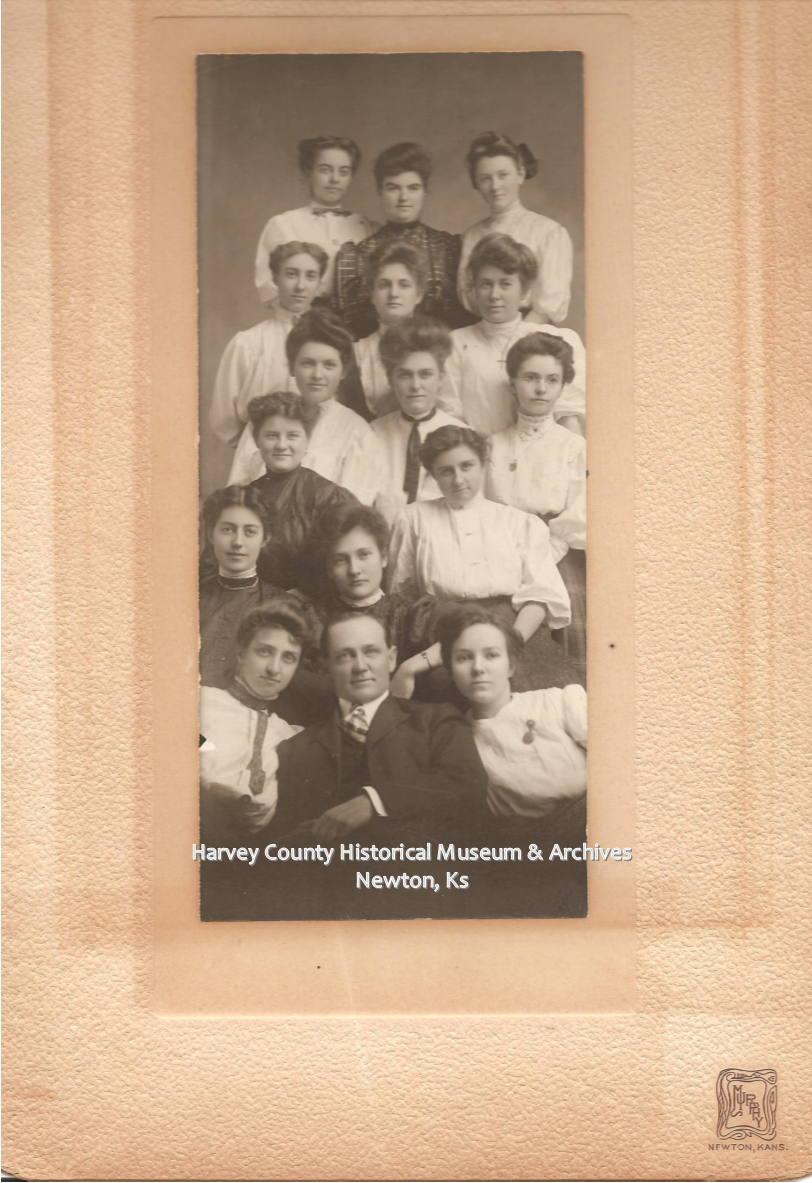
In our Photo Collection, one of the categories is  “Unidentified People.”  Some are a complete mystery with no clue as to place, date or names.  Others, like the photo of the group of young women below,  have a few clues including the photographers mark and several names on the back.  We would like to see if we could find out more about this photograph.

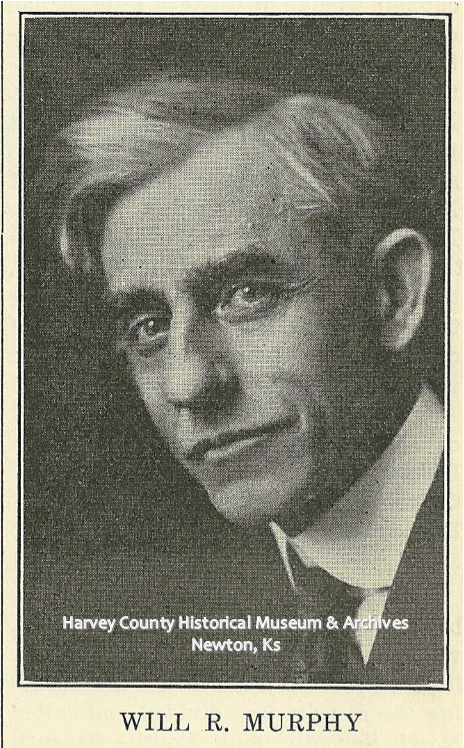
The photo was taken by local photographer, William R. Murphy.  Murphy  was a prolific photographer in Newton from 1897 to 1941.

William R. Murphy in the 50th Anniversary Ed of the Newton Kansan, 22 August 1922.

William R. Murphy in the 50th Anniversary Ed of the Newton Kansan, 22 August 1922.

He left Newton in 1941, for health reasons, and died in 1947.We have over 200 photos in our collection with the Murphy Studio mark.

The subjects are fifteen well-dressed young women and one man.

Murphy Photograph

Murphy Photograph

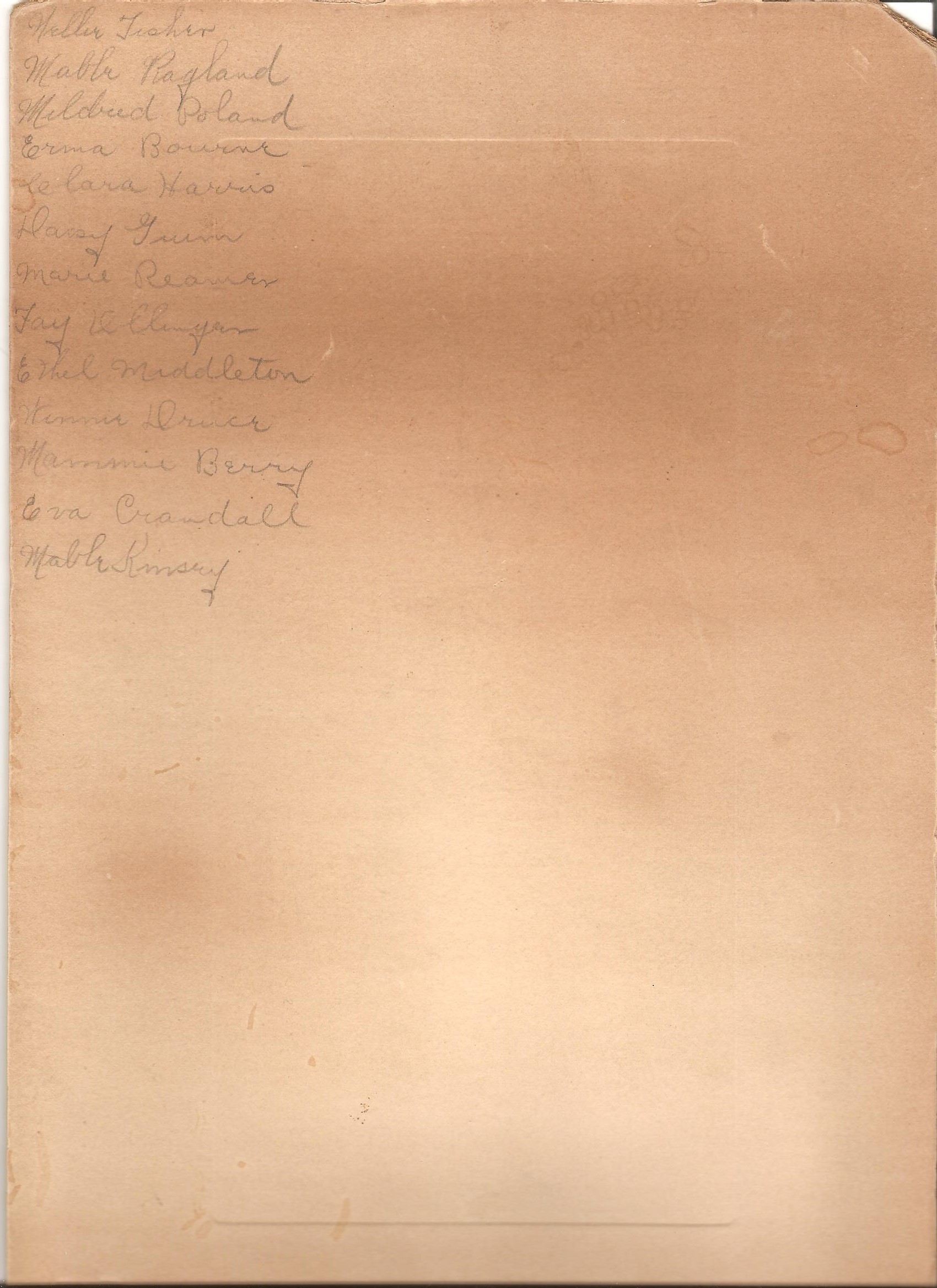
Names are listed on back, but the list does not include everyone and the order may not correspond with the actual photo.

 Nellie Fisher, Mable Ragland, Mildred Poland, Erma Bowink (?), Helena (?)Harris, Daisy Guinn (?),Marie R (?), Fay Ollinger, Ethel Middleton, Winnie Dreier, Mammie Berry, Eva Crandall, Mable Kinsey.

Back of Murphy Photograph

Back of Murphy Photograph

Who were the individuals? What was the occasion?

We do know that Mamie Berry Parsons was a piano teacher later in life. Was this a group of piano students? Or a school group? Or a group of friends?

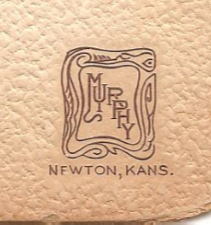
Murphy Logo

Murphy Logo

If you have any information, please contact John Whitlock, HCHM Photo Curator at pictures@hchm.org or 316-283-2221.

In a later blog post, we will feature William R. Murphy and his work as a photographer in Harvey County.  If you have any photos that were taken by him, we would love to hear from you.

Sources:

  • Evening Kansan Republican, 7 November 1947
  • Newton Kansan 50th Anniversary Ed, 22 August 1922.
  • HCHM Photo Archives

“Bake in Glass!” 100 Years of Pyrex, 1915-2015

by Kristine Schmucker, HCHM Curator

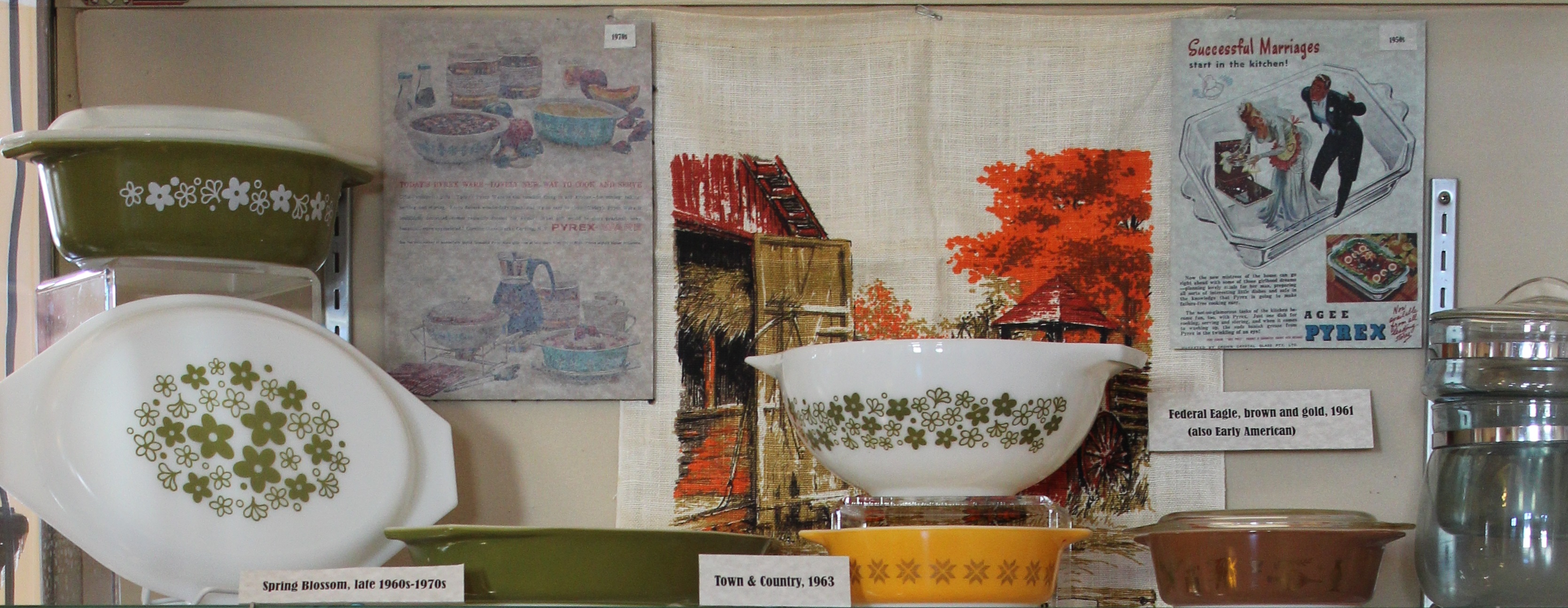
Our exhibit, The Colorful Kitchen: 100 years of Pyrex, 1915-2015, opened this week and we have already had several interesting conversations with people that have stopped by.  One interesting discussion involves ‘old’ Pyrex and ‘new’ Pyrex- is there a difference?

Exhibit Photo

Exhibit Photo

In 1913,  Corning chemist, Dr. Jesse T. Littleton, gave his wife, Becky, a Nomex battery jar, cut in half to use for baking.  The results were a happy surprise. Becky noted that food baked in the glass jar baked as well as, if not better than traditional ceramic dishes.  The glass used in the battery jars was made with borosilicate glass which was also used in weather shock-resistant lantern globes.

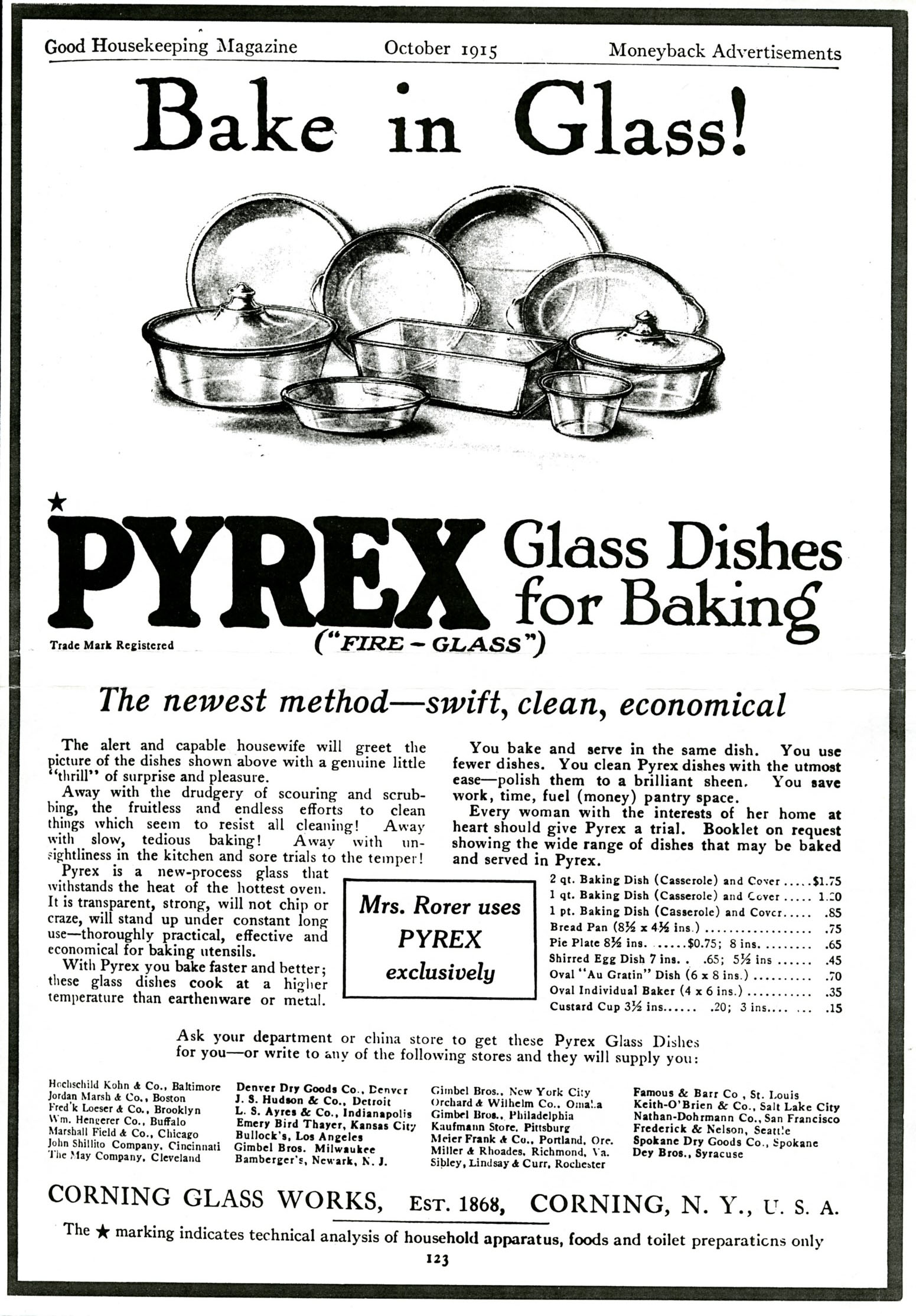
Pyrex was first sold in 1915.

Good Housekeeping Ad, 1915.

Good Housekeeping Ad, 1915.

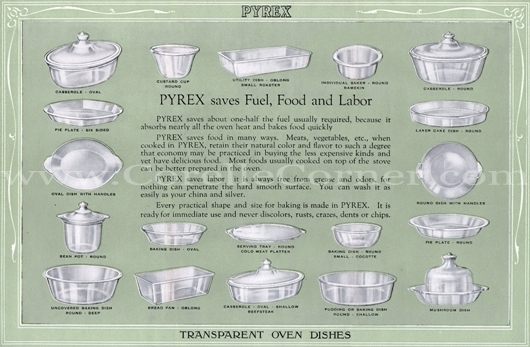
The first Pryex pieces were clear.

Pyrex, 1918

Pyrex, 1918

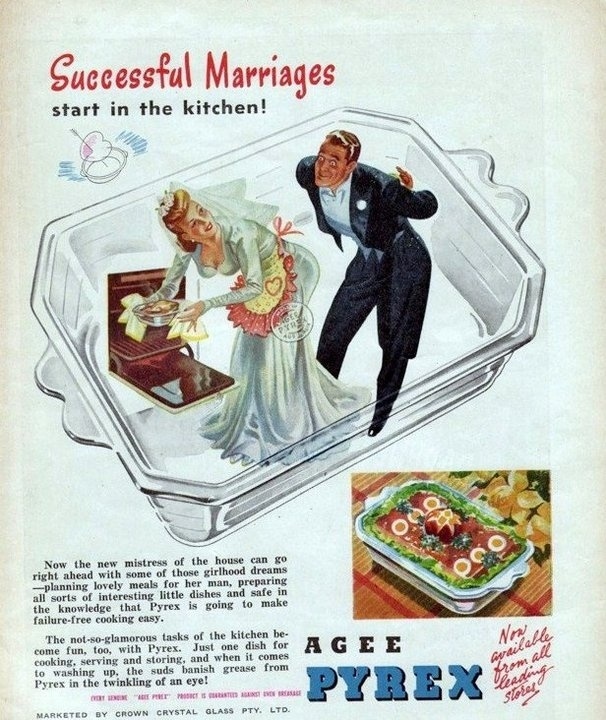
Eventually, patterns were added. During the 1950s and 60s, the dishes became popular wedding presents.

Pyrex ad, 1950s

Pyrex ad, 1950s

Pyrex remains popular today, but are the new dishes as good as vintage pieces? Consumer Reports Magazine conducted some experiments to determine the truth.

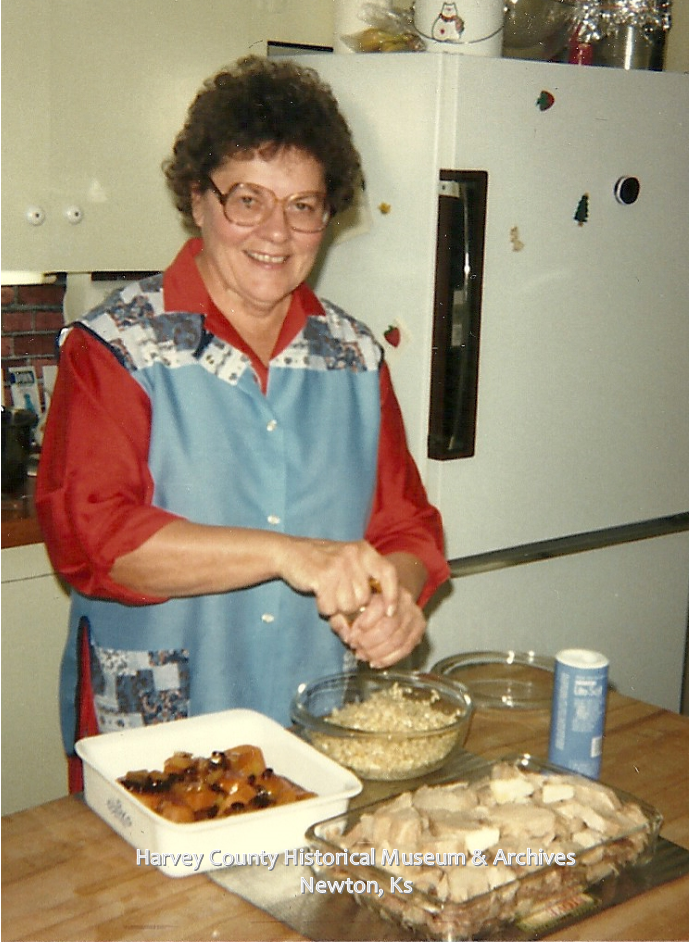
Marion Utz Nickel, December 1985.

Marion Utz Nickel, December 1985.

According to an article in the January 2011 Consumer Reports  Magazine the formula used to make Pyrex underwent a change after World Kitchen and Anchor Hocking took over the manufacture of the glass in the 1980s and 90s.  The original 1915 formula used borosilicate to strengthen the glass, but at some point a switch was made to the less expensive soda lime glass in the U.S..

There are questions about when this change occurred.  Some maintain that the borosiliacate glass was phased out almost 60 years ago, but most experts note that the lime soda glass was likely phased in during the 1980s. At least one executive scientist at Corning reported that borosiliacate was still in use in 1987, when he retired. Whenever the change occurred, the newer Pyrex is usually lighter and according to some more likely to explode under extreme temperatures. European Pyrex is still made with the borosiliacate glass.

Consumer Reports conducted several experiments on Pyrex in 2011 and the results can be seen at this link.   http://www.consumerreports.org/cro/magazine-archive/2011/january/home-garden/glass-cookware/glass-cookware/index.htm. The results of the experiments do suggest that newer Pyrex is more likely to shatter under extreme temperatures.  Older Pyrex and Pyrex from Europe did break occasionally, but at a significantly higher temperature than new dishes.

One Pyrex collector noted:

“I don’t use new Pyrex . . . it is not as durable as the vintage Pyrex.  While I have no problem baking in a dish that is forty years old or more, I’m not comfortable using a Pyrex baking dish made in 2013. Two different products entirely.  Yes, I’ve had new Pyres dishes explode on me.” -Christy Jordan, southernplate.com

Regardless, Consumer Reports urged cooks to read the directions for proper care and use of  Pyrex, no matter what the age, to minimize the possibility of breakage.

Our exhibit will be open through December 3, 2015 during regular museum hours: Tues-Fri 10-4 and the first and third Saturday of the month from 10-4.

Sources:

  • “A New Formula” at www.consumerreports.org/cro/magazine-archive/2011/january/home-garden/glass
  • http://www.pyrexlove.com/vintage-pyrex-pattern-guide/
  • http://www.southernplate.com/2013/02/pyrex.html
  • Bulls, Diana.  A Kitchen Staple Since 1915″ at kingsriverlife.com/06/23/pyrex-a-kitchen-staple-since-1915.